The Future of Fertilizers: Coated for Efficiency. The global population, projected to reach 8.5 billion in 2030 and 9.7 billion in 2050, is driving a growing demand for food. Consequently, one of the primary challenges facing modern agriculture is finding ways to improve crop growth and quality through sustainable agricultural practices. These practices aim to ensure a sufficient supply of high-quality food for the growing population. The answer to this challenge can be found in new methods and technologies applied in the agrochemical industry, including slow-release fertilizers (SRF) and controlled-release fertilizers. (CRF).
Sustainable agriculture is also a critical issue in the context of ongoing climate change. This includes water resource management and availability, as well as environmental pollution and the progressive loss of biodiversity. Moreover, climate change is leading to imbalances in food supply. This makes it difficult to address the challenges associated with meeting the ever-growing demand for food due to population growth, especially in developing countries.
 The “White Paper – Adaptation to Climate Change: towards a European Framework for Action” is an important strategic document of the European Commission. It defines the European framework for addressing the impacts of climate change. This has allowed for the integration of this adaptation into key EU policy areas. These include health and social policy, agriculture and forestry, biodiversity and ecosystems, water management, and economic sectors.
Additionally, the “Farm to Fork” strategy is a key element of the European Green Deal, considering the challenges associated with the need to implement sustainable food systems in a comprehensive manner, as they provide benefits at multiple levels, including environmental, social, health, and economic factors.
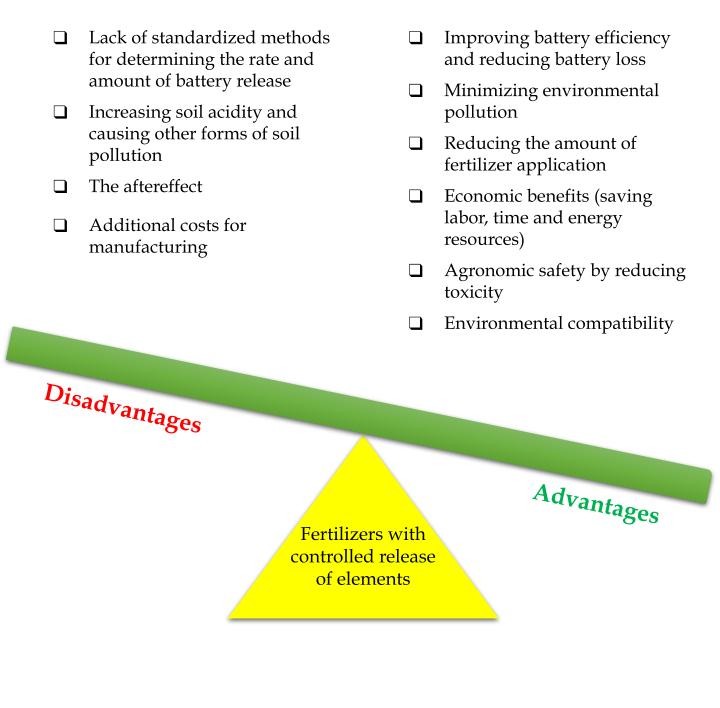
 Fertilizers such as CRF and SRF are a response to the challenges and issues outlined above. They offer an alternative means of achieving higher agronomic efficiency compared to conventional fertilizers. This is due to their slow and/or controlled release of nutrients, aimed at achieving better synchronization with plant growth cycles. This approach minimizes environmental pollution. For example, nitrogen fertilizers with slow or controlled release achieve higher agronomic efficiency and crop yields compared to conventional fertilizers.
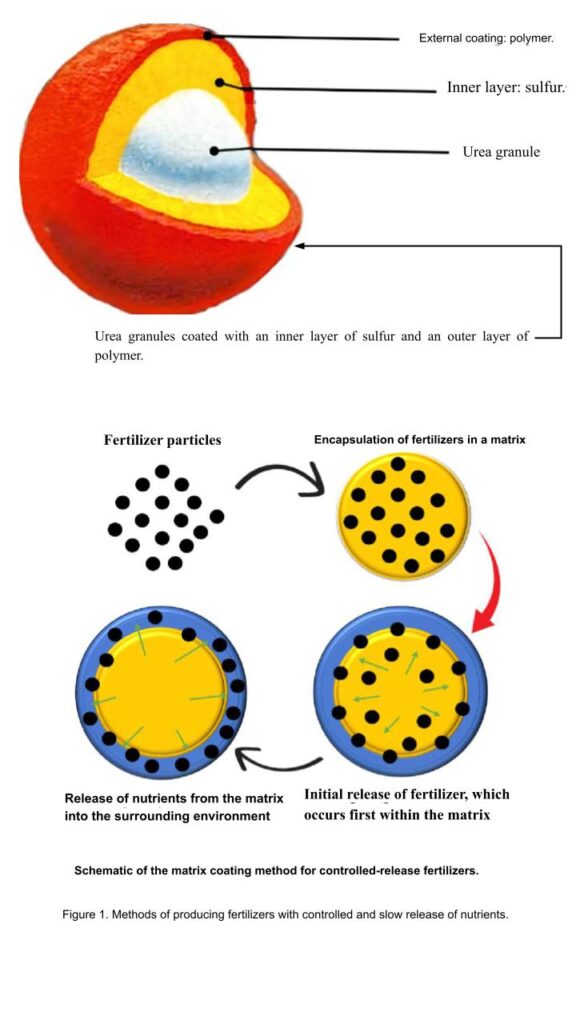
Slow- and controlled-release fertilizers are produced in two ways. The first is by encapsulating fertilizer granules in a matrix, and the second is by coating fertilizer granules (Figure 1). The coating method is further divided into two methods: chemical and physical.
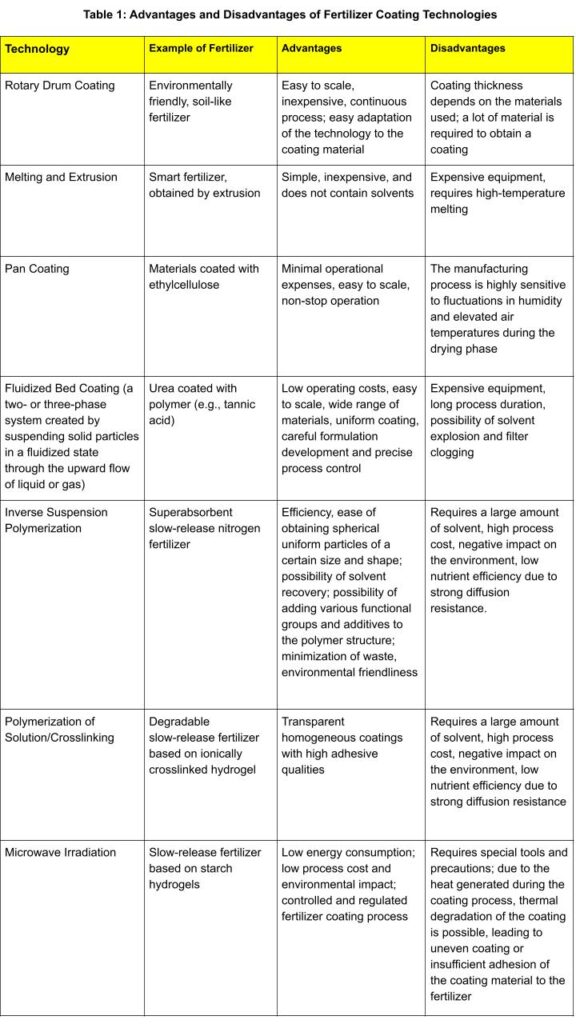
Physical methods include fluidized bed coating, pan coating, rotary drum coating, and melting and extrusion (as a single method). Chemical methods include inverse suspension polymerization, solution polymerization/crosslinking, and microwave irradiation (Figure 2). The advantages and disadvantages of fertilizer coating methods are summarized in Table 1.
Coating technology is promising. It can transform conventional fertilizers into smart and sustainable products that increase crop yield and quality. At the same time, it reduces environmental pollution, hazardous diseases, and costs. However, there are still many challenges in this field. These include the selection and optimization of coating materials and methods, as well as the evaluation and adjustment of coating characteristics and safety.
Therefore, to achieve this goal, it is first necessary to know the different methods. By understanding and considering the advantages and disadvantages of each technique, the best choice can be made depending on the existing conditions. As a result, these cases can be important and useful for farmers, scientists, and even students whose research area is related to the production of slow-release fertilizers.