


Recommendations and fertilizer rates for cotton

- To exact determination and calculation the required amount of fertilizer application, it is recommended to conduct soil agrochemical analysis, taking into account the planned yield indicators.
- We recommend to discuss nutritional special aspects with your regional manager.
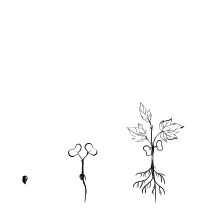
BBCH 13-19
(Leaves development)
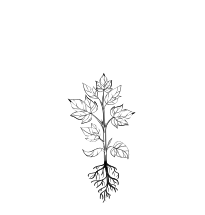
BBCH 21-29
(Shoot development)
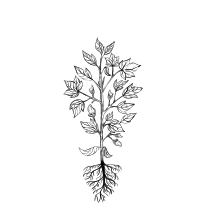
BBCH 31-39
(Stem elongation)
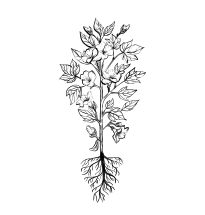
BBCH 51-59
(Earing)
BBCH 13-19
(Leaves development)
(Leaves development)
This macro stage develops from the first true leaf and continues up to nine or more true leaves. First, the rudimentary stem nodes and internodes are established. The plant needs sufficient supplies of macronutrients such as phosphorus and potassium. When exposed to environmental and anthropogenic influences, amino acids are needed to eliminate them.
Leaves originate on the sides of the shoot tip. A local concentration of cell divisions marks the very beginning of the leaf; these cells then enlarge to form a nipple-shaped structure called a leaf support. The cells of the leaf support can be derived from the sheath or from the sheath and the hull. The support then becomes more and more flattened in the transverse plane due to laterally oriented cell divisions and subsequent expansion on both sides.
After that, the prop becomes more and more flattened in the transverse plane due to laterally oriented cell divisions and subsequent expansion on both sides. The dividing zones are the marginal meristems, through the activity of which the leaf acquires its lamellar shape. In each meristem, the outer array of cells or marginal initials contribute to the epidermal layers by prolonged division. The cells below, the submarginal initials, provide the tissue of the inner part of the leaf.
Usually, a certain number of cell layers are defined in the mesophyll (the parenchyma between the epidermal layers of the leaf). Cell division is not limited to the region of the marginal meristems, but continues throughout the leaf in each of the layers, always in the same plane, until the final cell number is approached. Then the rate decreases, terminating in different layers at different times. The divisions usually end first in the epidermis, then in the lower layers of the leaf mesophyll.

More about the product
- Form: Liquid
- Packaging: 1l, 5 l, 20 l, 1000 l
Mn
Manganese chelate
SO₃
Sulfur trioxide
Zn
Zink chelate
Cu
Copper сhelate
Fe
Iron chelate
Mo
Molybdenum
B
Boron
Amino acids
Vegetable origin
pH
Density
(kg/l)
Your future harvest in this package!

More about the product
- Form:
- Packaging: 1l, 5 l, 20 l, 1000 l
P₂O₅
Phosphorus pentoxide
N
Total Nitrogen
B
Boron
Zn
Zinc chelate
Amino acids
Vegetable origin
Organic acids
pH
Density
(kg/l)
Your future harvest in this package!

More about the product
- Form: Liquid
- Packaging: 1l, 5 l, 20 l, 1000 l
N
Total Nitrogen
MgO
Magnesium oxide
SO₃
Sulfur trioxide
B
Boron
Cu
Copper сhelate
Zn
Zink chelate
Fe
Iron chelat
Mn
Manganese chelate
Amino acids
Vegetable origin
Organic acids
pH
Density
(kg/l)
Your future harvest in this package!

More about the product
- Form: Crystalline water soluble
- Packaging: 25 kg
N
Total Nitrogen
P₂O₅
Phosphorus pentoxide
K₂O
Potassium oxide
Zn
Zinc chelate (Zn EDTA)
Your future harvest in this package!

More about the product
- Form: Liquid
- Packaging: 20 l
N
Total Nitrogen
P₂O₅
Phosphorus pentoxide
K₂O
Potassium oxide
MgO
Magnesium oxide
SO₃
Sulfur trioxide
Zn
Zinc chelate
B
Boron
Fe
Iron chelate
Cu
Copper chelate
Mn
Manganese chelate
Mo
Molybdenum
Amino acids
Vegetable origin
pH
Density
(kg/l)
Your future harvest in this package!
BBCH 21-29
(Shoot development)
(Shoot development)
During the development of the indicated macro stage, the differentiation of the main axis of the germinal inflorescence occurs. The actual number of flowers is determined. During the period of intensive development from the phase of formation of lateral shoots/bushing to the phase of flowering it is necessary to have enough of these types of reserves: macro-, meso- and microelements for the full development of all plant organs.
The shoots of most vascular plants branch out according to a sequential plan, with actually each new axis arising at an angle between the leaf and the stem, i.e. in the leaf axil. In some plants, buds may also be formed from older parts of the shoot or root distant from the main apices; these buds, called adventitious buds, do not follow the general plan. The apex of the lateral shoot begins on the sides of the main apex, but some distance below the point of emergence of the youngest leaf rudiment.
As in the origin of the leaf, usually the outer cell layers contribute to the surface tissues of the new apex, maintaining a consistent pattern of divisions. In some species, a sheath of more than one cell layer quickly forms, so that the new apex looks like a miniature version of the main one.
Alternatively, differentiation cannot become evident until a significant mass of the new initial state has been reached. In all cases, the new apex must reach a minimum volume before it can, in turn, begin to form its lateral rudiments and organize true axillary buds. When this size is reached, zoning occurs.
Like the beginning of the main apex, the formation of new rudiments is associated with the annular zone. From this point, the development of a lateral shoot is the same as the development of the main shoot, except that growth may not be as fast, because the main apex or leading bud dominates and absorbs most of the available nutrients.
Early axillary bud growth is quite vigorous until a certain number of leaf buds are formed; then the apex activity slows down. Cell division gradually ceases, and with it the associated syntheses; thus, there is no increase in DNA of meristem nuclei after the last division. The kidney essentially goes into a dormant state, even if external conditions for growth are favorable. This phenomenon is known as correlative bud oppression, because it is determined by the activity of the conducting bud of the shoot. If the main, i.e. leading bud is removed, the inhibited lateral buds restore growth, and with it all associated syntheses.
More about the product
- Form: Liquid
- Packaging: 1l, 5 l, 20 l, 1000 l
Mn
Manganese chelate
SO₃
Sulfur trioxide
Zn
Zink chelate
Cu
Copper сhelate
Fe
Iron chelate
Mo
Molybdenum
B
Boron
Amino acids
Vegetable origin
pH
Density
(kg/l)
Your future harvest in this package!
More about the product
- Form: Liquid
- Packaging: 1l, 5 l, 20 l, 1000 l
N
Total Nitrogen
MgO
Magnesium oxide
SO₃
Sulfur trioxide
B
Boron
Cu
Copper сhelate
Zn
Zink chelate
Fe
Iron chelat
Mn
Manganese chelate
Amino acids
Vegetable origin
Organic acids
pH
Density
(kg/l)
Your future harvest in this package!

More about the product
- Form: Crystalline water soluble
- Packaging: 25 kg
N
Total Nitrogen
P₂O₅
Phosphorus pentoxide
K₂O
Potassium oxide
Cu
Сopper chelate (EDTA)
Mn
Manganese chelate (EDTA)
Zn
Zinc chelate (EDTA)
Your future harvest in this package!

More about the product
- Form: Liquid
- Packaging: 1l, 5 l, 20 l, 1000 l
N
Total Nitrogen
P₂O₅
Phosphorus pentoxide water soluble
K₂O
Potassium oxide
Organic acids
MgO
Magnesium oxide
Amino acids
Vegetable origin
pH
Density
(kg/l)
Your future harvest in this package!
BBCH 31-39
(Stem elongation)
(Stem elongation)
To disclose in detail this macro stage, it is necessary to indicate that here occurs the formation of second-order growth cones, the formation of the available number of flowers in the inflorescence with the laying down of flower covering organs, the formation of anthers (microsporogenesis) and stigmas (megasporogenesis), the formation of a larger number of synchronously developed productive stems. There is intensive growth of organs in length, formation of ovules and pollen grains.
Applying nitrogen and phosphorus fertilizers can increase the number of flowers in an inflorescence. Although the structural organization of the vascular plant is relatively loose, the development of different parts is well coordinated. Control depends on the movement of chemicals, including nutrients and hormones. An example of correlation is shoot and root growth. The increase in the aerial part is accompanied by an increased need for water, minerals and mechanical support, which are satisfied by the coordinated growth of the root system. Several factors seem to be involved in control, as the shoot and the root affect each other mutually. The root depends on the shoot for organic nutrients, just as the shoot depends on the root for water and inorganic nutrients, and thus the flow of ordinary nutrients must play a role. However, more specific control can be provided by supplying the nutrients needed in very small quantities.
The root depends on the shoot for certain vitamins, and changes in supply reflecting the metabolic state of the above-ground parts can also affect root growth. In addition, hormonal factors affecting cell division pass upward from the root to the stem; although the exact role of hormones has not yet been established with certainty, they may be one of the ways in which the root system can influence the activity of the shoot apex. Secondary thickening control is another important example of growth correlation. As the size of the shoot system increases, the need for both greater mechanical support and enhanced transport of water, minerals, and elements is met by increased coverage of the stem through the activity of the vascular cambium. As a rule, the cambium of trees in temperate zones is most active in spring, when buds are budding and shoots are sprouting, creating a need for nutrients.
Cell division begins on each shoot and then spreads out from it. The terminal bud stimulates the cambium to divide rapidly through the action of two groups of plant hormones: auxins and gibberellins.
Inhibition of lateral buds, another example of a correlated growth reaction, illustrates a reaction opposite to that occurring when controlling cambial activity. Lateral buds are generally depressed, as axillary shoots grow slower or do not grow at all, while the terminal bud is active. This so-called apical dominance is responsible for the characteristic unit of trunk growth observed in many conifers and herbaceous plants, such as the mallow. Weaker dominance leads to a form with multiple branching. This fact that the lateral or axillary buds become more active when the terminal bud is removed is evidence of hormonal control. The flow of auxin from the shoot apex is partially responsible for the inhibition of axillary buds.
The nutritional status of the plant also plays a role, as verticillium dominance is strong when mineral supply and light are insufficient. Since the axillary buds are released from inhibition by treatment with substances that stimulate cell division, also called cytokinins, it has been suggested that these substances are also involved in the regulation of bud’s activity.
More about the product
- Form: Liquid
- Packaging: 1l, 5 l, 20 l, 1000 l
Mn
Manganese chelate
SO₃
Sulfur trioxide
Zn
Zink chelate
Cu
Copper сhelate
Fe
Iron chelate
Mo
Molybdenum
B
Boron
Amino acids
Vegetable origin
pH
Density
(kg/l)
Your future harvest in this package!

More about the product
- Form: Liquid
- Packaging: 1l, 5 l, 20 l, 1000 l
Zn
Zinc chelate
N
Total Nitrogen
SO₃
Sulfur trioxide
Amino acids
Vegetable origin
Organic acids
pH
Density
(kg/l)
Your future harvest in this package!
More about the product
- Form: Liquid
- Packaging: 1l, 5 l, 20 l, 1000 l
N
Total Nitrogen
MgO
Magnesium oxide
SO₃
Sulfur trioxide
B
Boron
Cu
Copper сhelate
Zn
Zink chelate
Fe
Iron chelat
Mn
Manganese chelate
Amino acids
Vegetable origin
Organic acids
pH
Density
(kg/l)
Your future harvest in this package!
More about the product
- Form: Liquid
- Packaging: 20 l
N
Total Nitrogen
P₂O₅
Phosphorus pentoxide
K₂O
Potassium oxide
MgO
Magnesium oxide
SO₃
Sulfur trioxide
Zn
Zinc chelate
B
Boron
Fe
Iron chelate
Cu
Copper chelate
Mn
Manganese chelate
Mo
Molybdenum
Amino acids
Vegetable origin
pH
Density
(kg/l)
Your future harvest in this package!

More about the product
- Form: Crystalline water soluble
- Packaging: 25 kg
N
Total Nitrogen
P₂O₅
Phosphorus pentoxide
K₂O
Potassium oxide
SO₃
Sulfur trioxide
Mo
Molybdenum
Your future harvest in this package!
BBCH 51-59
(Earing)
(Earing)
In this macro stage, the processes of formation of all the organs of the flower inflorescence are completed, the development from the rudiments of the flowers to their opening takes place. The largest upper internode continues to grow.
Application of complex fertilizers with an emphasis on nitrogen and trace elements – zinc.
From the point of view of development, a flower can be considered as the axis of a shoot of deterministic growth, with the lateral members occupying areas of leaves that differentiate as floral organs — sepals, petals, stamens, and pistils. In transition to flowering, the stem apex undergoes characteristic changes, the most noticeable of which is the shape of the apical region, which is related to the type of structure to be formed, whether it is a single flower, as in a tulip, or a cluster of flowers (inflorescence), as in a lilac. The area of cell division extends to the entire tip, and the RNA content of the terminal cells increases. As a single flower forms, lateral primordia appear higher and higher on the sides of the apical dome, and the entire apex is absorbed in the process, after which apical growth ceases.

More about the product
- Form: Liquid
- Packaging: 1l, 5 l, 20 l, 1000 l
Mn
Manganese chelate
N
Total Nitrogen
SO₃
Sulfur trioxide
Amino acids
Vegetable origin
pH
Density
(kg/l)
Your future harvest in this package!

More about the product
- Form: Crystalline water soluble
- Packaging: 25 kg
N
Total Nitrogen
P₂O₅
Phosphorus pentoxide
K₂O
Potassium oxide
SO₃
Sulfur trioxide
B₂O₃
Total Boron trioxide
Your future harvest in this package!

More about the product
- Form: Crystalline water soluble
- Packaging: 20 kg
B
Boron
Your future harvest in this package!

More about the product
- Form: Liquid
- Packaging: 20 l
N
Total Nitrogen
P₂O₅
Phosphorus pentoxide
K₂O
Potassium oxide
MgO
Magnesium oxide
SO₃
Sulfur trioxide
B
Boron
Zn
Zinc chelate
Fe
Iron chelate
Cu
Copper chelate
Mn
Manganese chelate
Mo
Molybdenum
Amino acids
Vegetable origin
pH
Density
(kg/l)
Your future harvest in this package!

More about the product
- Form: Liquid
- Packaging: 1l, 5 l, 20 l, 1000 l
B
Boron
N
Total Nitrogen
Aminoacids
Vegetable origin
pH
Density
(kg/l)
Your future harvest in this package!
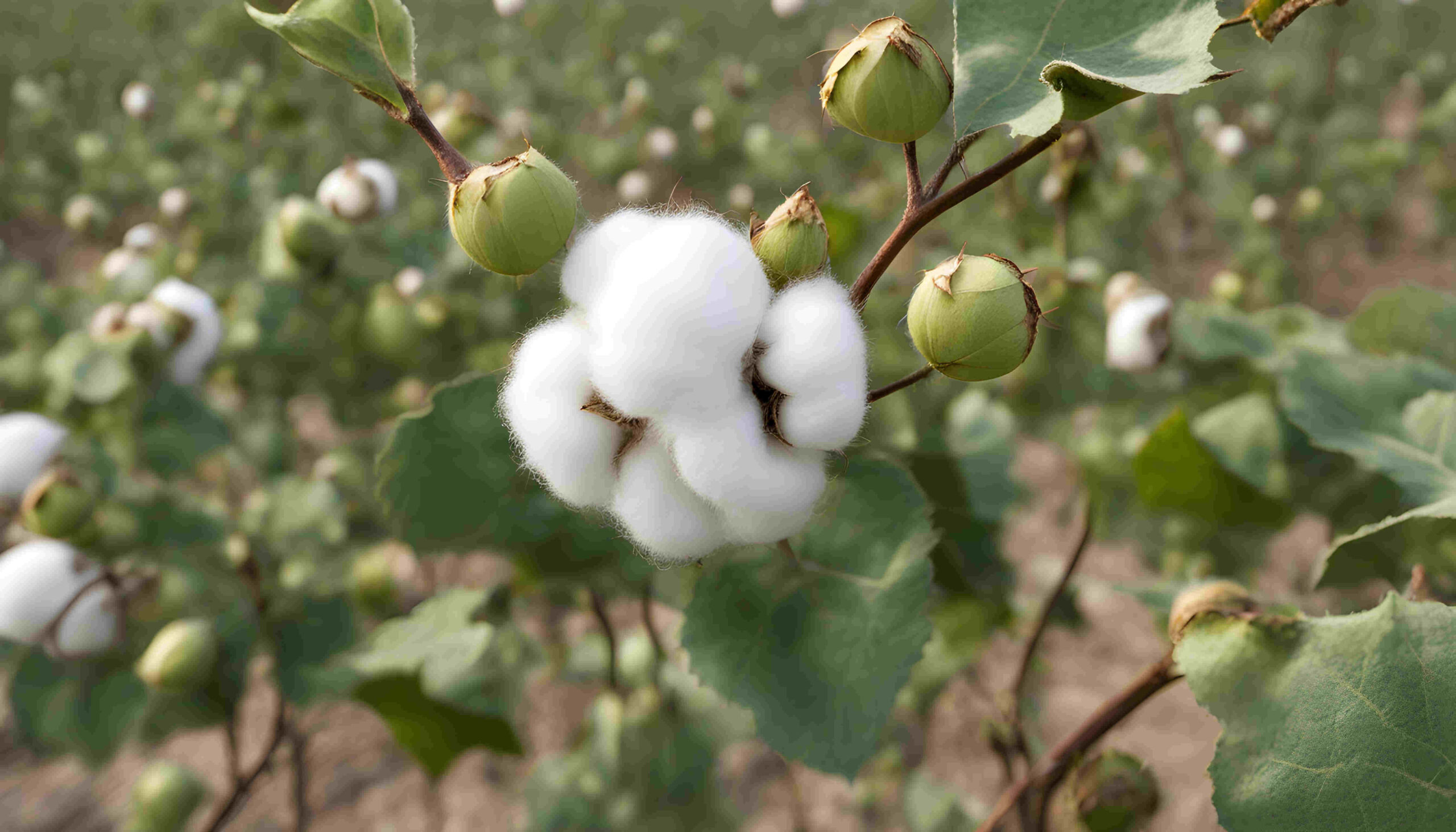

Cotton (Gossypium) is a genus of perennial plants belonging to the Malvaceae family. Cotton fibers, derived from the seed pods of these plants, are widely used in the textile industry. Cotton is one of the leading agricultural crops globally.
The various cotton species cultivated as agricultural crops originate from most subtropical regions worldwide. They have been domesticated independently multiple times. Cotton thrives in warm climates. The United States, Uzbekistan, India, and China are the top producers. These countries account for the majority of the world’s supply.
Turkey, Brazil, and Pakistan are also among the leading global producers of this crop.
In tropical climates, cotton can be found as perennial tree-like plants. However, for cultivation purposes, it is typically grown as an annual in temperate climates. In terms of size, cotton can reach heights of up to 6 meters (20 feet) in the tropics, while the average height in temperate regions is typically between 1 and 2 meters (3-6.5 feet).
Although cotton can be grown between latitudes 30° N and 30° S, climatic conditions significantly impact yield and fiber quality. The best qualities are achieved with high humidity levels resulting from rainfall or irrigation during the growing season and a dry, warm period during the harvest season.
Cotton can thrive in various soil types as long as they are well-drained, which is often the case on gentle slopes. However, sandy loam soil rich in clay and organic matter, with normal levels of nitrogen (N) and phosphorus (P), is generally considered ideal for cotton cultivation. Clayey soils with high calcium carbonate content typically produce the highest yields. The optimal pH range for cotton cultivation is between slightly acidic and slightly alkaline (5.8 and 8.0). Yield reductions are generally minor until the pH drops below 5.5 on sandy loams and 5.2 on silt loams.
Cotton cultivation demands careful consideration of soil characteristics. Requirements may vary among different varieties due to differences in root systems and leaf area. American upland varieties have deep roots and broad leaves. They thrive in deep, heavy, well-irrigated soils. Indian Desi varieties have shallow roots and smaller leaves. They are well-suited for shallow sandy soils with low moisture content.
To maximize yield and ensure fiber quality, meticulous plant care is crucial. It is essential to remain mindful of the plant’s needs at different growth stages. If you’re new to cotton cultivation, here’s a quick guide on how to get started:
A primary consideration in cotton cultivation is the plant’s water requirements, particularly in hot and dry conditions. Water consumption steadily increases from the leaf development stage (BBCH 13-19), when moisture loss occurs primarily through transpiration, to later stages. In addition to adequate irrigation, foliar nutrition should not be overlooked during this and other stages of cotton cultivation.
During the initial stages of cotton growth, phosphorus (Wonder Leaf Mono P 30, phosphorus content 30%) plays a pivotal role in promoting root system development, energy metabolism, photosynthesis, and overall plant health. Foliar application of this fertilizer at a rate of 1-2 l/ha is recommended for cotton.
As the plant progresses to the shoot development stage (BBCH 21-29), enriching it with readily available macro- and micronutrients (nitrogen, phosphorus, potassium, copper, and manganese). Choosing the best fertilizer for cotton growth depends on the specific soil conditions, nutrient availability, and growth stage of the plant. However, complex fertilizers generally promote efficient photosynthesis and energy exchange, which are critical for shoot growth and biomass production. Additionally, complex fertilizers enhance the plant’s ability to withstand stress factors such as drought, temperature fluctuations, and pests.
For cotton plants in the shoot development stage, we recommend using Wonder Leaf Yellow (N:P:K-21:21:21 + Cu-0.5, Mn-0.5, Zn-0.5 w/w %), a balanced, universal, crystalline, and water-soluble fertilizer with a high content of readily available macro- and micronutrients in chelated form. The recommended application rate for cotton plants in the shoot development stage is 2-4 kg/ha.
During the stem elongation stage (BBCH 31-39), zinc (Wonder Leaf Mono Zn 8) assumes significance in cotton plants. It plays a crucial role in maintaining osmotic balance within cells, influencing cell turgor and, consequently, shoot strength. Additionally, this micronutrient helps protect cells from damage caused by reactive oxygen species, which can be particularly important during periods of rapid growth. The recommended application rate for Wonder Leaf Mono Zn 8 foliar fertilizer is 1-2 l/ha.
Bud formation (BBCH 51-59) marks a crucial stage for foliar nutrition in cotton cultivation. During this period, active cell growth and division occur within flower buds, paving the way for the development of floral structures. However, the plant may also exhibit increased sensitivity to various stress factors, such as drought, temperature fluctuations, pests, and diseases. Therefore, providing optimal growing conditions is paramount.
To support the intensive growth and development of buds, the cotton plant demands a higher supply of water, macroelements, and micronutrients. Phosphorus, potassium, calcium, and micronutrients like boron and zinc play particularly important roles.
Our agronomic experts recommend using Wonder Leaf Blossom foliar fertilizer for cotton plants during the bud formation stage. This unique formula is specifically designed to provide the essential elements required for this phase: potassium (7%) and boron (0.7%). These elements stimulate nutrient uptake by cotton, enhancing flower size and color intensity, and promoting vibrant and prolonged flowering. The recommended application rate for Wonder Leaf Blossom on cotton plants is 4-5 l/ha.
Contact us in order to receive cooperation terms and details
Partners are our customers and suppliers, whom we care about and who determine our path.


