Ion antagonism and synergism: known and unknown element combinations
Ion antagonism and synergism: known and unknown element combinations
Plants are sedentary organisms that are constantly exposed to various biogenic stresses that often occur in the soil and the environment. Nitrogen (N), phosphorus (P), sulfur (S), zinc (Zn) and iron (Fe) are five essential nutrients that significantly affect plant growth and development. Despite their importance, these elements are often difficult for plants to access due to their low solubility and limited mobility in the soil. However, to cope with these challenges, plants have developed mechanisms to survive under multifactorial stress and limited nutrient uptake.
The interactions between N, Pi (inorganic phosphate), S, Zn and Fe at the physiological level have been studied. However, the molecular mechanisms and signaling pathways that mediate these interactions remain largely unknown. In this article, we review recent studies on the biochemical and physiological interactions between macro- and micronutrients in plants, with a particular focus on their cross-talk involving N, Pi, S, Zn, and Fe uptake and homeostasis. Ultimately, a comprehensive understanding of the cross-talk of multi-nutrient signaling in plants is of important biological significance and crucial for the sustainable advancement of agriculture.
Functional plant ionome: complex cross-links between macro- and microelements (element combinations)
More than a decade ago, the concept of “ionome” was understood as “the composition of mineral nutrients and microelements of a living organism”. Recently, some scientists have proposed a new concept of “functional ionome”, which includes all mineral elements necessary for the growth and development of living organisms. These elements can be classified into the macroelements N, P, K, S, Mg and Ca. And the microelements Zn, Fe, Cu, Mn, Mo, Ni and B (Fig. 1). However, several previous studies have shown that three additional elements, including Si (silicon), Co (cobalt) and Se (selenium), are also necessary for optimal plant growth.
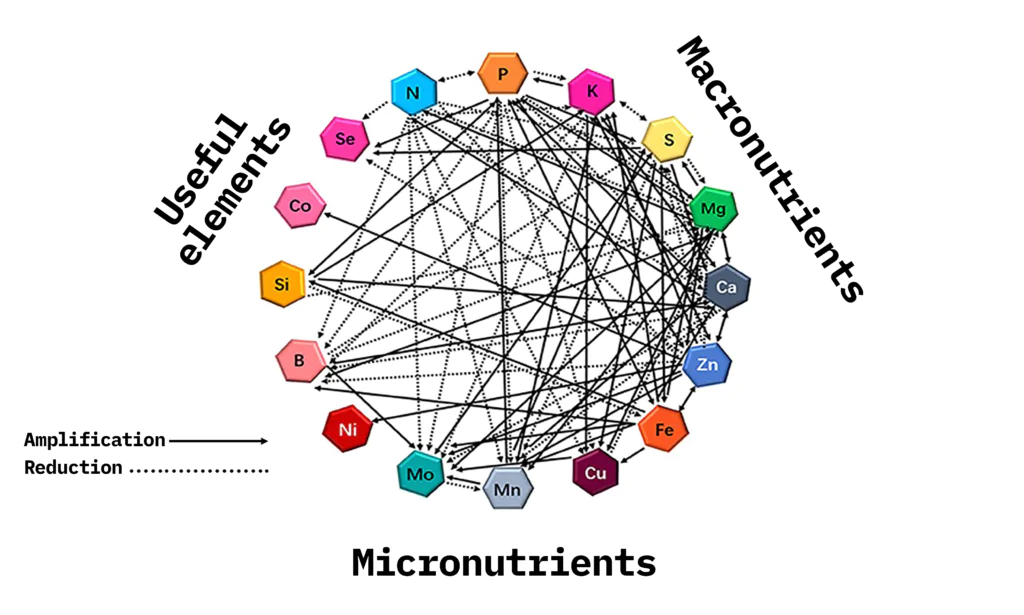
Fig. 1. Cross-talk between macro- and micronutrients or beneficial elements in plants in response to individual mineral deficiencies. Interactions resulting from the deficiency of one element (any of the 16 elements) lead to increased (solid lines) or decreased (dashed lines) uptake of other minerals. Nutrient deficiency can modify the “functional ion” of plant tissues. Scientists have identified 18 different interactions in rapeseed plants under mineral nutrient deficiency at the uptake level. In particular, Mo uptake was significantly increased in plants deficient in S, Fe, Zn, Cu, Mn or B (Fig. 1), it was suggested that this result may be due to direct and indirect disturbances in Mo and S metabolism, leading to an increase in their transporters.
Si and Zn cross-linking influences the “functional ionome” of maize.
Providing maize plants with Si and/or Zn significantly reduces the concentration of Pi, K, Mg, Ca, Mn, Ni, and Co in roots. But increases the concentration of Se. The positive effect of the interaction of Si and Fe on the growth and productivity of vegetables and cereals has also been reported. Thus, the dynamics of the “functional ionome” of plants exposed to individual mineral deficiencies indicate the complexity and diversity of interactions between individual plant mineral nutrients. Overall, these ionomic analyses further confirm the emergence of complex cross-linking relationships between mineral nutrients in plants, indicating that under certain deficiencies. Cross-linking stimulates or inhibits the accumulation of other mineral nutrients, which changes the ionic composition of plant tissues.
In addition, several studies have examined physiological and genetic interactions between plant nutrients using combined ionomics and genome-wide association study (GWAS) approaches. The application of low Pi to goosefoot cultivation affected the concentrations of other nutrients. With significant increases in Zn, Fe, S and decreases in Cu and Co concentrations in the test plants. With the rapid development of multiple approaches, as well as systems biology, progress has been made in understanding the molecular mechanisms underlying physiological and genetic processes resulting from multiple nutrient signals.
In terrestrial ecosystems, higher plants are sedentary organisms and face variable environmental stresses (element combinations)
…. including soil nutrient deficiencies and high-activity metals, which significantly affect plant survival and development. In particular, crop plants grown in soil are exposed to nutrient stresses throughout their life cycle, such as low or high levels of essential mineral elements, including N, P, S, Zn, and Fe. Therefore, plants have developed efficient mechanisms to co-regulate these stimuli to maintain nutrient homeostasis. To date, the unexpected cross-talk between macro- and micromineral elements in plants has long been recognized at the morphological and physiological levels. However, despite their fundamental importance, the molecular basis, regulatory networks, and biological significance of these interactions in plants remain poorly understood. Recently, several studies have focused on the analysis of plant nutrition.
Considering two or more nutrient combinations, and suggested that the homeostasis of N, Pi, Zn and/or Fe is highly regulated in plants at different hierarchical levels. On the one hand, synergistic effects between N and P, as well as N and Zn in rice plants have been demonstrated at the levels of nutrient signaling and transport. On the other hand, antagonistic interactions between P and Zn, P and Fe, and Zn and Fe have been noted in the field of plant nutrition at the levels of transcriptional response, nutrient perception, signaling and transport.