 Cultivating tomatoes is a rewarding and profitable endeavor that yields an abundance of fresh, nutritious fruit. To achieve a bountiful harvest, it is crucial to understand the intricacies of tomato cultivation, encompassing soil selection, irrigation practices, and essential care measures. Additionally, proactive measures must be taken to safeguard crops from the detrimental effects of plant diseases and pests.
Modern Tomato Cultivation Techniques
Contemporary tomato cultivation techniques embrace innovative agricultural practices, continuous plant monitoring, and the utilization of reliable data for weather anomaly forecasting and problem identification. By embracing these advancements, growers can optimize their yields and minimize crop losses.
Key Factors for Successful Tomato Cultivation
1. Understanding Plant Biology: Before embarking on the cultivation journey, it is essential to familiarize oneself with the biological characteristics and cultivation requirements of tomatoes.
Tomatoes are heat- and light-loving plants, thriving within a temperature range of 23-25°C. At temperatures below 15°C, flowering ceases, and growth stalls at 10°C. Frost exposure proves fatal to tomato plants.
Tomato cultivation necessitates well-drained, fertile, and warm soils with neutral pH levels. Moderate irrigation is essential, while excessive soil and air moisture promote fungal and bacterial diseases.
2. Crop Rotation: Employing a strategic crop rotation plan is paramount for successful tomato cultivation. Ideal crop predecessors include legumes, perennial grasses, cucumbers, onions, and cabbages. Avoid planting tomato seedlings or seeds after nightshade crops (potatoes, eggplants, peppers) or in close proximity to them. This practice minimizes the risk of encountering prevalent diseases and pests shared among these closely related crops.
Reintroducing tomatoes to the same plot should occur no sooner than 3-4 years after the previous cultivation cycle.
3. Soil Preparation: Proper soil preparation commences in autumn. Incorporate organic fertilizers at a rate of 4-6 kg/m² of fresh cow manure, 2-4 kg/m² of semi-decomposed crop residues, or the following average mineral fertilizer application rates (per active ingredient): nitrogen 10-12 g/m², phosphorus 10-11 g/m², and potassium 17-19 g/m².
If combining organic and mineral fertilizers, reduce the mineral fertilizer application by 40%. Apply the mixture prior to sowing. For exclusive mineral fertilizer use, apply 50% in autumn and the remaining 50% before sowing.
Select fertilizers based on soil pH and application method. Ideally, conduct an agrochemical analysis to determine nutrient deficiencies and choose suitable fertilizers accordingly. Perform plowing or manual digging to a depth of 25-30 cm in autumn, followed by spring cultivation and harrowing.
4. Choosing a tomato variety or hybrid:
For outdoor cultivation, it is advisable to grow determinant or semi-determinant tomato varieties. Indeterminate varieties are not well suited for planting in open ground, as they need to be trellised and grown in a greenhouse if conditions are not suitable for a long growing season.
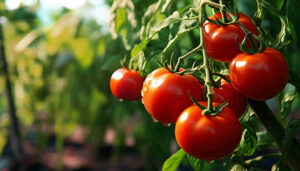
5. Sowing and planting seedlings:
Sowing and planting tomatoes in open ground begins after the threat of spring frosts has passed, depending on the climatic region and weather conditions. It is important that planting or sowing of tomatoes is carried out in one row with a distance between rows of 1.4-1.6 m on drip irrigation, and if there is no irrigation, the rows can be reduced to 1.2 m. Two-row planting patterns are also possible, for example, 170+40×40 centimeters. Do not exceed the sowing or planting density, as this can lead to a decrease in yield. There is also a risk that the fruits may become small and diseases may begin to develop.
6. Plant formation:
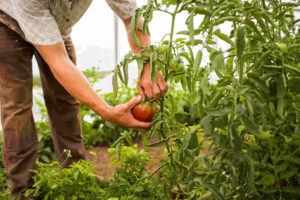
When growing tomatoes without tying, there is no need for pinching. Pinching tomatoes is the process of removing axillary, or lateral, shoots that grow from the leaf axils between the plant’s main stem and branches. These shoots, also known as suckers, tend to consume a lot of the plant’s nutrients and energy, which can lead to reduced fruiting and decreased fruit quality. Therefore, pinching helps plants redirect resources toward the growth and development of fruits, contributing to a larger yield and improved fruit quality.
One of the advantages of pinching is the ability to create denser plantings. When tomatoes are left unshaped, they take up more space, potentially interfering with neighboring plants. Removing suckers allows the bushes to be more compact, aiding in the efficient use of available space and improving the cultivation and care of the crop.
In open ground, only large-fruited determinant tomatoes are grown on several stems. To do this, a replacement sucker is left below the 3rd inflorescence. The top is pinched, leaving 2-3 leaves above the last inflorescence. After 2-3 brushes form, the procedure should be repeated.
7. Fertilization of tomatoes:
It should be noted that green manure, compost heaps, saturation with positive microorganisms and Californian worms give a fairly good result in increasing soil fertility. It is not recommended to turn the soil when applying them. Organic fertilizers, which are applied under the previous crop, also give a good result. For this, 20-40 t/ha of fresh manure is used.
During the growing season of plants, mineral fertilizers are applied, the norms of which are calculated after agrochemical analysis of the soil. Fertilizers are selected according to the soil pH and the method of application.
If sprinkler irrigation is used on the site, then phosphorus and potassium fertilizers are applied for plowing. The application of nitrogen fertilizers is divided into 3 stages: the first with spring cultivation, the second during fruit setting, and the third after 3-5 weeks.
When growing tomatoes on drip irrigation, fertilizers must be applied frequently but in small amounts during the growing season. This method is the most acceptable, because with its help the plants will receive the necessary elements at the right time. Also, observing the plants after applying this or that fertilizer, it is possible to adjust the rates of application of N: P: K.
At the initial stages of growth and development of the plant, namely in the phase of leaf growth and development BBCH 13-19 (Leaf development), tomatoes can be subjected to sharp spring temperature fluctuations. Very often, an anthocyanin color (transition from blue to violet in colors) can be seen on the leaves of plants. It is for this reason that the application of phosphorus fertilizers (Wonder Leaf Blue, Wonder Leaf Mono P30) in the norms indicated by the manufacturer is used. If the plants are subjected to stress caused by the environment (sharp temperature drops, prolonged temperature drops and waterlogged soil), or an anthropogenic factor – the introduction of herbicides, then amino acids of plant origin (Wonder Leaf Green and Wonder Leaf Amino 43) are used.
At the same time, chelate complexes of microelements are also used (for example, foliar fertilizers Wonder Leaf Mono Zn 8, Wonder Leaf Mono Cu 6, Wonder Leaf Mono B 120). With the use of microelements, complex compounds are formed from nucleic acids, which affect the properties of cells, root development, the formation of reproductive organs, etc. They take part in the processes of respiration and photosynthesis, (carbohydrate, fat and protein metabolism), the formation of enzymes and acids, the process of nitrogen fixation, and the transformation of phosphorus compounds. It is desirable that the chelating agent be glycine. Due to the fact that the glycine molecule is much smaller than the molecule of chelating agents that are usually used (for example, EDTA, EDDHA), the fertilizer that contains it has a higher concentration of microelements. In addition, it is a component of proteins, and therefore, together with microelements, it is built into the plant skeleton.
In fact, chelates of synthetic origin are unknown in the environment, therefore, during their assimilation by the plant, it loses a lot of energy to process or remove foreign synthetic ligands in the body during the assimilation process. Their role is only to carry out the role of transporting biological microelements in the plant. When using chelate compounds, the plant “takes” only the nutrient element, and the chelator itself (as unnecessary ballast) gets into the soil and accumulates.
Phosphorus fertilizers, amino acids and microelement complexes can be mixed together in a tank mixture, it is better that it is from the same manufacturer who has a table of mixing these components. If the manufacturers are different, then it is better to mix in small proportions beforehand. If the solution does not become cloudy and does not precipitate, then it can be applied. The tank mixture must be used within a few hours after mixing. It is better to avoid raising the temperature above 25 ° C and direct sunlight. The most effective will be the treatment in the morning and evening hours. An important factor is the use of adjuvants (spreader, sticker and pH regulator) since they help the prepared working solution to spread over the surface of the plant, to be retained on the surface and not to precipitate products using alkaline water.
In the future, when plants experience intensive growth, it is necessary to monitor the plants to avoid the manifestation of deficiencies in macro- and microelements. The best fertilizers for foliar feeding are complex fertilizers with an emphasis on nitrogen (for example, the ratio of N: P: K – 3: 1: 1) – Wonder Leaf Violet because the plant has intensive growth and it needs a complex of microelements in chelated forms. We recommend using foliar fertilizers Wonder Leaf Veg&Fruit, Wonder Leaf Wonder Micro in agriculture.
As plants transition to the fruit and seed formation stage (BBCS 71-79), it’s crucial to monitor them closely to prevent macro-, meso-, and micronutrient deficiencies. To address these nutrient needs, foliar application of complex fertilizers with a high potassium content is recommended. An ideal N:P:K ratio for this stage is 1:0.5:2.1, which can be achieved with fertilizers like Wonder Leaf Red and Wonder Leaf Mono K30. Additionally, incorporating a complex of chelated microelements into the foliar feeding regimen is essential.
Calcium supplementation is also paramount during this phase. Calcium deficiency manifests as yellowing of the upper leaves while the lower leaves remain green, and the fruits become susceptible to blossom-end rot. To combat calcium deficiency, Wonder Leaf CaO+B or Wonder Leaf Mono Ca 14 are highly recommended fertilizers.
In essence, cultivating tomatoes necessitates a well-structured strategy that encompasses meticulous planning and execution of field operations. Selecting optimal varieties, maintaining soil health and fertility, employing effective pest and disease control measures, and adopting innovative agricultural practices are all key elements that contribute to the sustainability of tomato production throughout the entire production cycle.
For further insights into the intricacies of fertilization and cultivation practices for coffee and cocoa, please follow this link: