


 Chlorophyll-free soil organisms are of the greatest biological and ecological importance in the microbiota. These include bacteria, fungi, actinomycetes, and the simplest of them (infusoria, amoebae, rootworms, etc.). Among them, nitrogen-fixing bacteria are very important.
For this reason, meeting the nitrogen needs of plants is more difficult task than meeting their needs for other mineral elements.
When growing crops, even on fertile soils, plants’ nitrogen demand is only partially met by its mobile compounds in the soil (from 30-40 to 60%). Only 2% of its total reserves are used from the soil. Plants receive enough nitrogen from the atmosphere, but they cannot assimilate free nitrogen from the air because they cannot overcome the forces of atomic bonding in its molecule.
Due to this huge reserves of nitrogen in the atmosphere are not available to plants. Unfortunately, mobile forms of nitrogen in the soil are also not fully absorbed by plants.
What are the sources of nitrogen supply?
It is believed that one of the sources of nitrogen supply is the binding of atmospheric nitrogen by microorganisms. Which, unlike plants, are able to oxidize molecular nitrogen. Mineral nitrogen fertilizers, a product of industrialized atmospheric molecular nitrogen binding, are also a source of nitrogen replenishment in the soil.
Bacteriorrhiza is the symbiosis of the roots of higher plants with nodule bacteria. They bind atmospheric nitrogen and convert it into available compounds, enriching the plant and soil with it.
Soybean roots (Glycine max; Soja hispida, Soja japonica), cowpeas or Chinese cowpea (Vigna unguiculata), common beans (Phaseolus vulgaris), peas (Pisum sativum), alfalfa (Medicago sativa), clover or shamrock (Trifolium) enter into symbiosis with bacteria (e.g.,Rhizobium and Bradyrhizobium) and form bacteriorrhizae. Microorganisms are part of the rhizosphere surrounding (the root system of plants).
The accumulation of a large number of bacteria in the rhizosphere is associated with the release of substances by the roots that feed these microorganisms. The number of microorganisms in the rhizosphere can be 50-100 times higher than their content in the surrounding soil. As it goes deeper, its activity decreases due to deteriorating air conditions, waterlogging, the content of iron and aluminum oxide forms, etc.
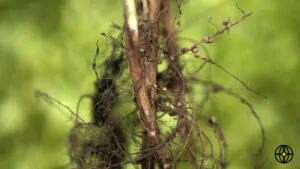
I would like to emphasize that, in order to adapt to the soil environment, the root system of plants can not only change morphological characteristics but also influence rhizosphere processes. This can occur through the regulation of the physiological activity of the roots, the release of organic compounds. Such compounds include acids, carbohydrates, enzymes and other signaling molecules), release of protons or changes in redox potential. However, root growth and rhizosphere processes affect the transformation of soil nutrient reserves, their mobilization and efficient use by plants.
How and where do bacteria live?
In fact, the bacteria live in the soil, where they come into contact with the root of Legumes (Fabaceae or Leguminosae). If it has the necessary set of genes, then symbiosis can occur. The bacteria enter the root fiber and move to the center of the fiber cells. Their accumulation and reproduction on the roots causes hypertrophic growth of the cortical parenchyma in the form of nodules of a specific shape. The nodule is formed by a bacterial nest connected to the conductive tissues of the root (phloem and xylem). Nodule bacteria are capable of fixing atmospheric nitrogen and converting it into nitrogenous organic compounds that plants use during mineralization. This interaction is a symbiosis: bacteria take carbohydrates from plants and give them nitrogenous mineral compounds.
The process of biological nitrogen fixation
The process of biological fixation of molecular nitrogen by prokaryotes, soil nitrogen-fixing microorganisms, is important for soil enrichment and crucial for agriculture.
Nitrogen-fixing microorganisms can absorb from 40 to more than 300 kg of nitrogen per hectare from the air each year. This nitrogen does not pollute the environment and does not require significant energy inputs for production. The importance of the biological nitrogen fixation process has been proven. For example, in global agricultural practice, 35 million tons of nitrogen are added to the soil with mineral fertilizers every year, while plants absorb approximately 75 million tons of this element from the soil over the same period. The difference between these values is compensated by the activity of nitrogen-fixing microbes. First of all, nodule bacteria, which bind molecular nitrogen into forms that are easily assimilated by the plant.
For high biological activity of the soil, it is necessary to ensure a neutral or close to neutral weakly acidic or weakly alkaline reaction of the soil solution. This is necessary because most microorganisms, especially bacteria and some fungi, do not develop in an acidic environment (at pH < 4.5 – 5.0). Also, if the crop rotation is broken, or the field was grown in monoculture, and the farmer plans to grow crops of the Legume family (Fabaceae or Leguminosae) this year, it is necessary to treat the seeds with inoculants (biological preparations that use live cultures of microorganisms beneficial to plants). They allow the plant to provide the necessary strains for symbiosis, which in turn will increase the amount of nitrogen and protein content.
Effect of macro-, meso- and microelements
The use of mineral and organic fertilizers in the crop rotation of any soil and climatic zone requires systematic monitoring of soil level supply with mobile forms of micro- and macroelements and their content in plants. This is especially true for legumes, which require much more trace elements for active nitrogen fixation and biomass formation.
It should be noted that nitrogen fertilizers in high doses delay the synthesis and activity of the structural complex of nitrogenase, a key enzyme of biological nitrogen fixation.
- Ammonia generated in the process of nitrogen fixation. It interacts with keto acids to form primary amino acids and amides, the synthesis of which occurs with the participation of a number of enzymes. Nitrate excesses entering the plant disrupts the normal metabolism of this process and the balance of the nitrogen cycle.
- With a low phosphorus content in the medium, the penetration of bacteria into the root hairs is reduced. At the same time, different cultures of nodule bacteria of the same plant species require different amounts of phosphorus for their growth and development.
- Potassium is important in legumes life. The lack of this element leads to a disorder of both nitrogen and hydrocarbon metabolism. Potassium starvation weakens the attachment of phosphorus to organic compounds. Legumes, especially lupine and clover, are less demanding on the level of mobile phosphate and exchangeable potassium in the soil than non-legumes. For this group of crops, a different criterion for providing soils with phosphorus and potassium is needed, as well as the calculation of phosphorus and potassium fertilizer doses for the planned harvest.
- The growth of roots and above-ground organs depends on the presence of calcium in the growing medium. In the absence of this element, cell walls become slimy. The walls of the root hairs are particularly severely affected, which prevents the infection of bean nodule bacteria.
- With a sufficient amount of calcium and magnesium in the medium, the cells of the nodule bacteria remain active for a long time. With the active participation of magnesium, the enzyme complex of nitrogenase is activated. Magnesium deficiency disrupts the growth of bacteria and reduces their vital activity.
For legumes, molybdenum and boron are particularly important trace elements. Lack of molybdenum inhibits the formation of nodules, disrupts the synthesis of free amino acids and leukemoglobin. Due to a lack of boron, vascular bundles do not form in the nodules, and, as a result, the development of bacteroid tissue is impaired. To overcome and prevent possible deficiencies in these important mineral nutrients, microfertilizers are used in production during pre-sowing seed treatment and foliar application.
 In addition to the above elements, other trace elements such as Cu, Zn, and Mn are also needed. They are involved in redox processes, hydrocarbon and nitrogen metabolism, and increase plant resistance to diseases and unfavorable environmental conditions
Copper, zinc, and manganese contribute to the accumulation of organic phosphorus compounds in plants and the supply of magnesium.
Manganese enhances the movement of phosphorus from aging leaves to young ones.
So, having understood all the concepts and processes that take place during the formation of legume roots, we can conclude that heat and moisture and nutrients alone are not enough to grow a good harvest.
We hope that the information we have covered in this article has been useful to you and will help you increase your harvest.


