Hello everyone!
Today, let’s talk about cocoa and the technology of foliar nutrition for it.
Cocoa (Theobroma cacao) is a tropical evergreen tree (family Malvaceae) grown for its edible seeds. Its scientific name means “food of the gods” in Greek. Its seeds, called cocoa beans, are processed into cocoa powder, cocoa butter, and chocolate.
Cocoa grows in the forest understory and reaches a height of 6-12 meters (20-40 feet), usually staying at the lower end of this range. Its oblong, leathery leaves reach 30 centimetres (12 inches) in length and are periodically shed and replaced with new leaves, which are bright red when young.
The flowers are tiny, only half an inch (1.25 cm) or so in diameter (1-2 cm). The flowers usually grow in clusters directly from the tree trunk or large branches.
Each flower needs pollination to produce a football-sized fruit – a pod with 30-60 seeds that can be processed to make chocolate. It sounds simple, but in reality, successful cocoa pollination is problematic in many regions. Only about 10%-20% of the flowers produced by a cocoa tree are successfully pollinated. The rest, up to 90%, never receive pollen – or do not receive enough pollen to produce fruit. Therefore, the insects responsible for pollinating the tiny cocoa flowers are themselves also tiny to gain access to the flower’s reproductive structures. Midges and gall midges are among the most important known cocoa pollinators worldwide.
Cocoa Trees: Growing Conditions and Cultivation
Cocoa trees thrive only in specific areas that meet their unique requirements. cocoa belt is a region of land around the equator that lies between 20 degrees north and south latitude. Most cocoa is grown within 10 degrees of the equator.
The soil must be well-drained, and the climate must be humid. Ideal temperatures range from 18 to 30 degrees Celsius (64 to 86 degrees Fahrenheit), and rainfall should be relatively constant, with at least 1000 mm (39 inches) per year. Cocoa trees cannot tolerate too much sun or too much shade. Cocoa can be grown up to 1000 meters (3280 feet) above sea level, but most are grown below 300 meters (984 feet).
Cocoa cultivation initially spread from the cocoa tree’s original habitat: from Brazil and Mexico to Central America and the Caribbean. In the 16th century, the Spanish introduced cocoa to the Indonesian archipelago and West Africa, which now accounts for more than half of the world’s annual crop. Production has also increased significantly in Southeast Asia.
Cocoa is cultivated in over thirty-five countries. The cultivated area covers 3.5 to 4.5 million hectares (8.6 to 11.1 million acres). This area yields an annual production of approximately 3.5 million tons of cocoa beans. The most important cocoa-producing countries are:
|
Côte d’Ivoire (Ivory Coast) |
2,019 thousand tons |
|
Ghana |
970 thousand tons |
|
Indonesia |
290 thousand tons |
|
Ecuador |
270 thousand tons |
|
Cameroon |
240 thousand tons |
|
Brazil |
174 thousand tons |
|
Nigeria |
230 thousand tons |
|
Peru |
110 thousand tons |
|
Dominican Republic |
75 thousand tons |

When soil lacks nutrients, it limits the growth and yield of cocoa trees, even if other growing conditions are ideal. Foliar fertilization can significantly impact yields and make inefficient soils suitable for cultivation.
→Nitrogen is one of the most needed nutrients for cocoa. It is necessary for vegetative growth, stimulating the development of branches and leaves.
Let’s examine the nutrient needs of cocoa trees at different stages of growth:
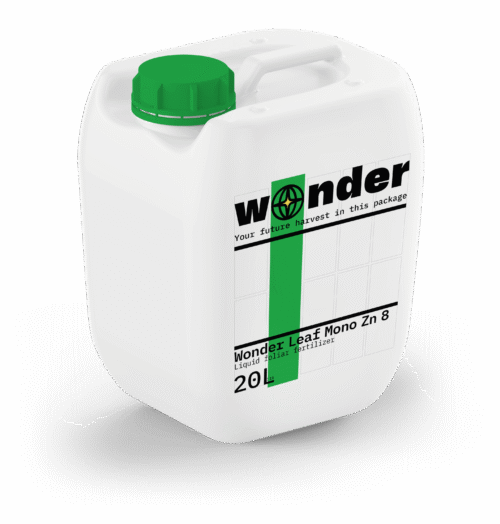
- BBCH 31-39 (Stem elongation). During this stage, the crop begins to consume nutrients actively. Plants primarily require nitrogen, with smaller amounts of phosphorus and potassium. Zinc is the most needed micronutrient at this stage. We recommend using Wonder Leaf Violet and Wonder Leaf Mono Zn 8. Since the crop is a lower-level plant, it requires iron to enhance photosynthesis in partial shade. Iron will prevent chlorosis, which can stunt the growth of young branches.
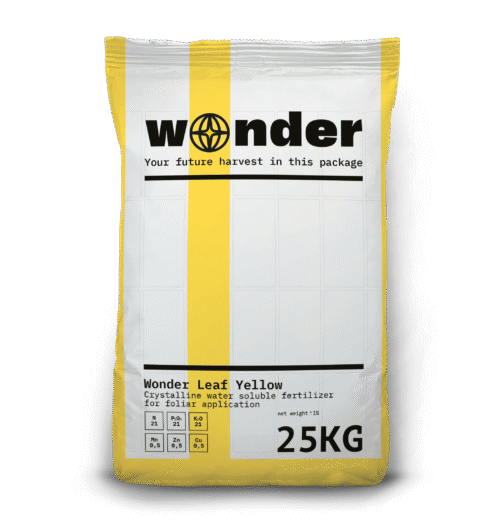
- BBCH 51-59 (Inflorescence – budding). At this stage of growth and development, it is especially important to apply macronutrients in equal proportions (boron and amino acids). During this phase, we recommend using the following products: Wonder Leaf Yellow, Wonder Leaf Mono B 11, and Wonder Leaf Amino 43. These elements stimulate bud activation. A well-developed flower will improve the pollination and fertilization process, leading to the formation of future fruit ovaries. Amino acids help prevent ovary drop.
- BBCH 67-69 (End of flowering – ovary formation). Recommended products for use in this phase are Wonder Leaf Violet and Wonder Leaf Veg&Fruit. Wonder Leaf Violet has a high nitrogen content and the microelement molybdenum, which is necessary in this phase, which increases the supply of nitrogen, thereby promoting ovary growth. Wonder Leaf Veg&Fruit is an enhanced complex of trace elements that provides an improvement in quality and quantity.
- BBCH 71-79 (Fruit and seed formation). At the beginning of this stage, we recommend applying Wonder Leaf Blossom fertilizer, followed by Wonder Leaf Veg&Fruit. Why Wonder Leaf Blossom? It is a complete fertilizer with a high content of potassium and boron. This combination increases sugar content and improves fruit quality.
In the middle and until the end of the fruit and seed development stage, we recommend using Wonder Leaf Mono Ca 14 fertilizer in combination with Wonder Leaf Mono B 11. Boron in the fertilizer improves the plant’s absorption of calcium. Calcium improves the marketable appearance by strengthening the fruit structure, which helps to prevent disease damage. At the same time, since the cocoa plant has a high potassium consumption index, we correct it with Wonder Leaf Red fertilizer, which contains 30% of this element without chlorine.
So you’ve harvested your cocoa, and the trees are now entering a dormant state (a temporary phenomenon). During this time, we recommend applying a phosphorus-based fertilizer. Phosphorus is essential for the development of roots, wood, and young shoots. A deficiency of this element can lead to stunted plants, narrow leaves, and early and severe leaf drop.
The copper in Wonder Leaf Mono Cu 6 has fungicidal properties and a tonic effect that improves overall tree performance by extending leaf retention. In case of iron deficiency, also known as chlorosis, it is recommended to use the fertilizer Wonder Leaf Mono Fe 10.
The insufficient availability of any micronutrients will limit the growth of cocoa – especially the productive leaf area – and reduce the yield. (Liebig’s Law of the Minimum)
For more information, please read this article.
Happy harvesting and see you next time!