 Plants, like us, need a variety of nutrients for healthy growth and development. Foliar feeding has become a widely used method of fertilization in recent times. Foliar or leaf feeding is a way of providing plants with essential nutrients through their leaves. (We suggest you take a closer look at our expert article, which will help you correctly determine the norms and doses of fertilizer application) . Nutrients are quickly absorbed by plants, and this method is often used to provide additional nutrition and correct deficiencies of specific elements. In this article, we will explore the basic principles and benefits of foliar feeding of plants, as well as assess its potential for increasing the productivity and resilience of crops in modern conditions!
What should you know about foliar feeding?
Discussions about foliar feeding often raise the question of the expediency of this measure, since the absorption of minerals is the job of the roots. This is true, but leaves also play a rather important role in crop nutrition, which has been confirmed by many scientific studies. The leaves of most plant species have a very good ability to absorb water, amino acids (for example, Wonder Leaf Amino 43), other organic compounds, and even whole minerals. In this article, we will explain in more detail how this process occurs.
In the process of evolution and development, plants have developed several systems that allow them to survive and reproduce successfully in adverse conditions. The intake of nutrients directly through the leaves is one of these irreplaceable reserve systems.
Foliar feeding in nature
A good example of the natural process of foliar feeding can be found in dark tropical forests. In forests where mainly tall trees grow, the penetration of direct sunlight to the undergrowth of grasses and shrubs is limited, and sometimes completely absent. This leads to a low level of photosynthesis, which causes a limited formation of simple sugars, which are necessary for the growth of plants, their roots, and root exudates.

The roots, in turn, receive a significant portion of these sugars. In turn, they distribute most of them into the surrounding soil, which serves as food for microorganisms in the rhizosphere. And microbes, in turn, release the necessary materials and organic particles for absorption by mycorrhiza and root hairs (not only ions are transferred).
With a low level of photosynthesis, less simple sugars enter the soil, which may be even more important. This leads to a limited retention of soil organisms, which is accompanied by limited absorption of mineral substances.
Pathogens are easily attracted to “simple” sugars. The more complex the sugars that a plant produces during photosynthesis, the greater its resistance to diseases. In dark forests, plants could never survive under low photosynthesis without alternative methods of producing quality sugar. Most plants have developed a secondary absorption system, actively absorbing amino acids, minerals, and even organic fractions of humus through their leaves. This natural foliar feeding comes from the upper layer of the forest, where small particles of organic dust, dead insects, bird droppings, algae, and flies collect. The nutrients that are released fall on the undergrowth plants. Since most cultivated plants come from forests, they can usually handle foliar feeding well.
For decades, researchers and various organizations have been looking for ways to maximize plant growth according to their genetic potential. Most crops grown under conventional fertilization systems are regularly treated with fungicides and insecticides and reach only 60-75% of their genetic growth potential. One of the factors limiting growth in organic farming is that plant fertilizer needs are often still based on ideas based on chemical fertilizers – a reference to our fertilizers on the website. Justus von Liebig’s “Law of the Minimum” only confirms this. (Read more about the law of the minimum in our article). Regular foliar feeding can be one of the ways to help get a healthier and more resilient crop, and even increase yields in both organic and conventional farming.
Mechanisms of Mineral and Amino Acid Absorption Through Leaves and Their Impact on Plants
There are three main ways in which minerals and amino acids can be absorbed through leaves:
- Through leaf hairs (trichomes).
- Through the waxy layer on leaves (cuticle). We recommend using Wonder Aqua True Cover.
- Through absorption and release by cells (endocytosis).
Most plant species have several hundred times more stomata on the lower leaf surface than on the upper surface. This is a very important sign that they are not designed to absorb water. Stomata are well equipped for breathing and evaporation, but as organs for absorbing water, they are as suitable for a plant as drinking through the lungs is for a human.
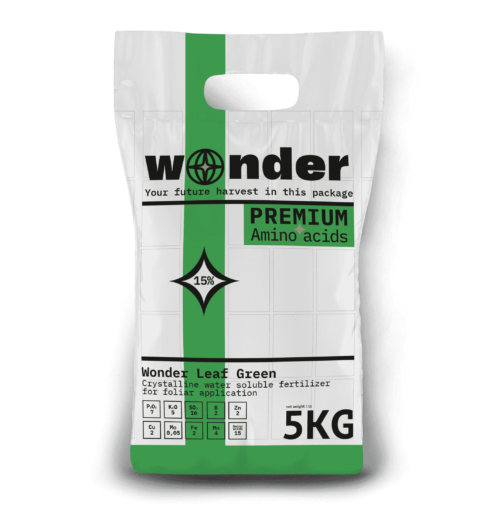
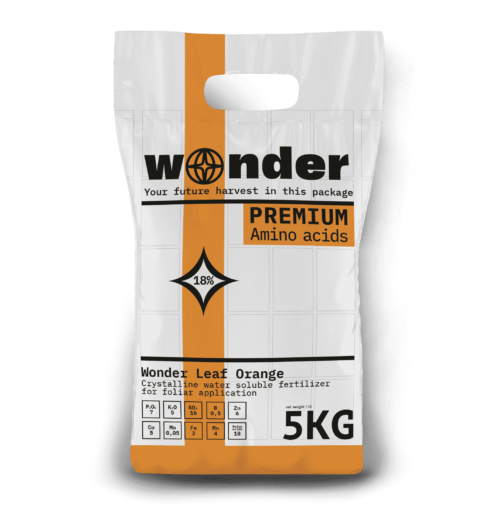
I would like to tell you more about the above-mentioned methods of nutrient absorption by leaves. Trichomes are unicellular outgrowths of the epidermis. Positively charged minerals and amino acids (Wonder Leaf Orange, Wonder Leaf Green, Wonder Leaf Amino 43) are usually well absorbed through these protrusions. Even negatively charged plants can draw a limited amount of positively charged foliar fertilizers through their waxy layer. It is important to note that organic foliar fertilizers usually do not pass through the cuticle (waxy layer). However, many chemicals, especially fungicides, pass through the waxy layer, dissolving it.
This is one of the reasons why chemical spraying needs to be repeated almost every week. After the waxy layer on the leaves is (partially) dissolved or holes appear, the leaves become practically defenseless and prone to attack by pathogens.
Through endocytosis, minerals lying on the surface of the leaf are surrounded by epidermal cells and transported to so-called storage cells (absorbent cells), which absorb and store minerals for later use.
The figure below shows the first stage of this process. In fact, the principle works similarly to patches on human skin, which gradually release drugs into the body through the skin.
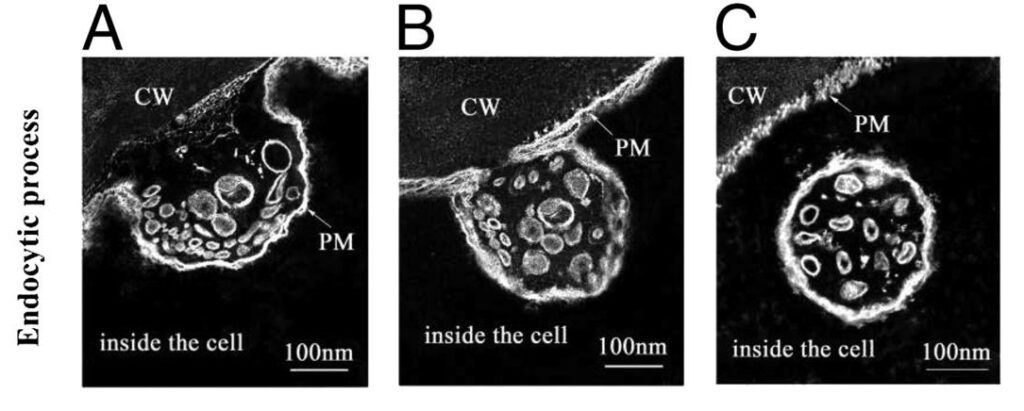
Nutrient uptake by the leaf through endocytosis
Alternative Sources of Soil Enrichment
For many decades, 17 well-known macro-, micro-, and meso-elements have been used worldwide as essential for plants, according to modern fertilization theory. With the addition of oxygen, water, and CO2, this number increases to 21 elements. However, some research supports the idea that plants extract much more from the soil than just minerals in the form of ions, as most researchers and agronomists have previously assumed. Many studies also confirm that more elements are needed for the healthy functioning of various organisms than those included in the general list. According to a growing body of scientific publications, it is now known that at least 30, and possibly even 60 elements, are necessary for humans and animals to maintain a healthy state. From this, the spectrum of commonly known nutrients required for plants is also broader than we used to think.
This includes a significant number of rare earth elements, which are present in tiny amounts in almost all soil types. Studies on the use of elements such as lanthanum and cerium in small doses show improvements in the quality and yield of some crops. Minerals that are necessary for growth can be classified as essential minerals.
Rare earth elements, which are not currently considered essential but have demonstrated effects on plant health, growth, flowering, fruiting, and germination, should be classified as beneficial. (Knowledge of the critical phases of plant growth and development is important, so we recommend that you read our expert article).
Alternative Sources of Soil Enrichment
It is now known that plants need more than 17 essential elements for healthy growth. There is also the possibility that after many years of mining, rare earth elements may disappear altogether or be present in insufficient quantities in agricultural soils. This depletion of the soil can also explain the decline in the nutritional value of agricultural and horticultural crops over the past 40 years.
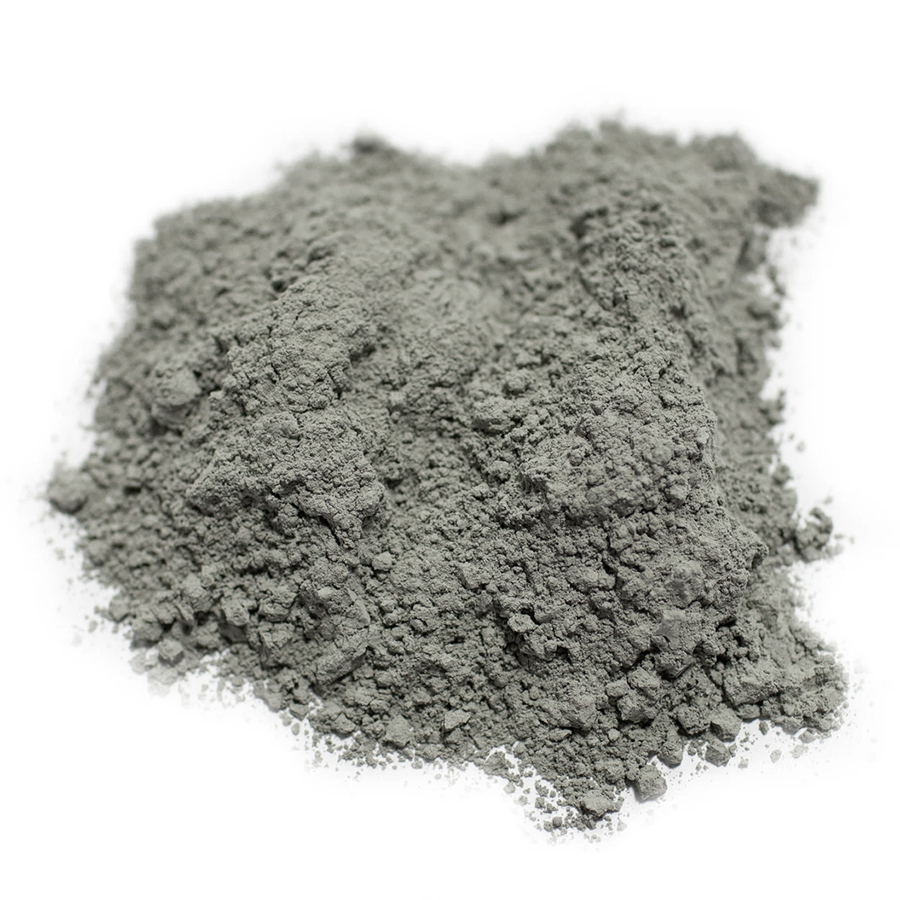
This progressive understanding has led both researchers and farmers to start using rock flour (also called rock dust) to enrich old agricultural lands. This freshly ground product contains trace elements that are not detected in any traditional fertilizer analysis. Countries such as the Netherlands, Germany, Switzerland, the USA, and Austria, in particular, have already gained enough positive experience in using rock dust.
How to increase yield?
To fully understand the situation and eliminate uncertainties, much more research needs to be done. While growers can wait for this, they can also anticipate possible prospects. One way to achieve goals may be to spread rock dust, or even better, to combine rock dust with beneficial soil bacteria.
One of the fastest methods to discover the value of a wide range of minerals for plants is the use of foliar fertilizers). Quality foliar fertilizers do not contain large amounts of nitrogen, but instead, they contain various amino acids, the content of which in the product ranges from 15 to 43%. They should contain a number of various elements that are found only in organic fertilizers. Plants respond quickly to foliar feeding, making it an effective method for growers to regulate plant growth, improve yields, and accelerate ripening. Foliar feeding is a natural process that has existed since plants began to grow on Earth.
Improving photosynthesis through foliar feeding
Plants suffering from heat or drought close their stomata to reduce moisture evaporation, which also reduces photosynthesis. At the same time, the intake of water and nutrients slows down or even stops. The result of this process is a serious decrease in growth potential. Providing additional irrigation in such conditions can reduce the negative consequences, especially when the temperature drops. As I mentioned above, a low level of photosynthesis leads to less formation of complex sugars, which makes the plant more vulnerable to diseases and pest attacks. The way out is to make sure that the plants intensify their photosynthesis so that they can quickly produce complex sugars.
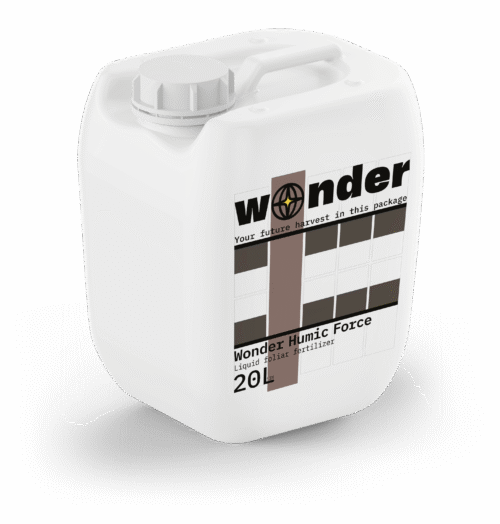
By applying fertilizers that are rich in organic matter and additionally enriched with macro- and microelements (Wonder Humic NPK), or fertilizers with organic matter in combination with amino acids (Wonder Humic Force), favorable conditions for plant growth can be created. This foliar feeding process does not cause leaf burn. However, it is recommended to apply them in the morning so that the plants can fully utilize the additional nutrients.
Plants respond quite quickly and positively to spraying and will show this by their reaction. An important “side effect” of foliar feeding is the formation of a high-quality sugar complex that nourishes the roots and rhizosphere. This promotes better support of mycorrhizal colonization of the roots and, accordingly, increases the water absorption capacity of plants.
The importance of foliar plant nutrition far exceeds the expectations of many. In the near future, farmers will discover the potential of foliar fertilizers.
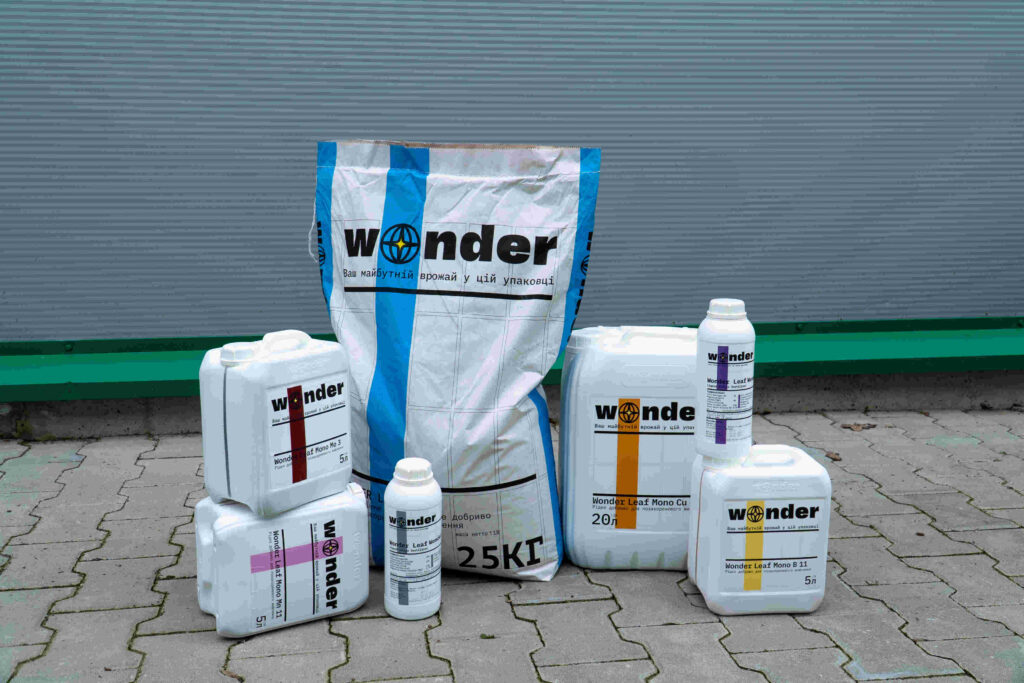
Thus, foliar feeding allows for the efficient absorption of nutrients through the leaves, a quick response to nutrient deficiencies and stressful situations, reduces fertilizer losses, and has a lower environmental impact compared to traditional methods (To learn more about the benefits of using microfertilizers, we suggest you read our article). Importantly, Wonder fertilizers open up new perspectives for the efficient provision of nutrients to plants through foliar feeding.
Foliar feeding of crops with Wonder fertilizers can contribute to increased yield, quality, and resilience of crops, as well as reduce the negative impact on the environment.