IMPACT OF NUTRIENTS ON PLANT DROUGHT RESISTANCE
IMPACT OF NUTRIENTS ON PLANT DROUGHT RESISTANCE
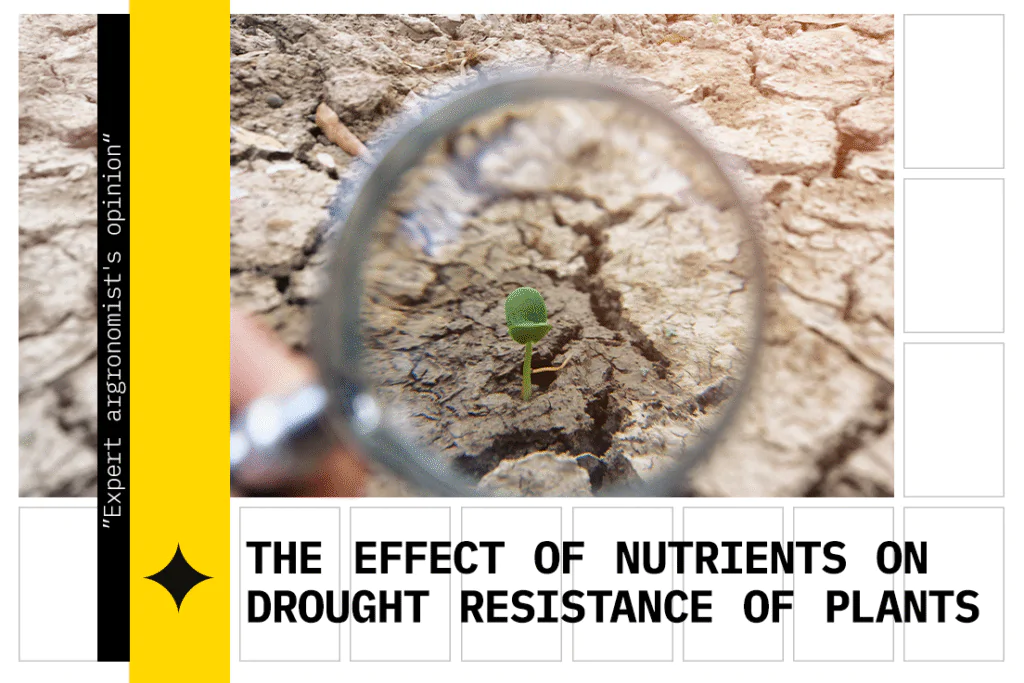
Can foliar application of nutrients improve plant drought resistance?
Each year, reports from global weather stations indicate that the previous year was the hottest on record. Extreme temperature readings are consistently observed in various locations across our planet. These fluctuating temperature increases have a destructive impact on plants, which require stable moisture and temperature conditions. Scientists in meteorology and climatology, as well as agricultural producers. Face challenges, including overcoming and preventing the negative consequences of global warming, which severely limit the achievement of planned high-quality yields.
It is known that soil application of fertilizers is less effective under conditions of insufficient soil moisture. Therefore, in modern intensive fertilization technologies, foliar application is gaining importance. Not only as an intensification factor but also as a means of improving overall nutrient conditions.
But are there nutrients that can not only directly influence yield indicators. But also contribute to plant resistance to negative biotic and abiotic environmental factors? Can nutrients strengthen cell walls, influence the opening or closing of stomata on leaves. Or promote the formation of specific growth regulators in plants capable of enhancing their resistance?
Evidently, yes. Numerous studies conducted in various research institutions demonstrate the direct and indirect influence of foliar feeding on the formation of plant defense mechanisms against unfavorable environmental factors. However, particular attention should be paid to elements that. Alone or in combination with others, contribute to enhancing plant resistance specifically to elevated temperatures and drought, as the consequences of global temperature increases lead to greater crop losses each year.
In the autumn of 2024, the journal Phyton – International Journal of Experimental Botany published research results that unequivocally demonstrate the effectiveness of combined foliar application of silicon and molybdenum. According to the results, exogenous silicon in the form of potassium silicate (1000 ppm) and molybdenum in the form of ammonium molybdate (100 ppm) improve the drought resistance of quinoa (Chenopodium quinoa Willd). The study was conducted using a randomized complete block design with three biological replicates. Treatments included T0 (control, water spray), T4 (drought stress). And T1, T2, T3, T5, T6, and T7. Which involved foliar application of silicon and molybdenum solutions separately and in combination.
The results showed that drought stress primarily affected quinoa yield by reducing growth, physiological, biochemical, metabolic, hormonal, antioxidant, and ionic properties. The addition of Si and Mo, however, improved:
- Growth characteristics. Shoot, panicle, and root length, number of leaves per plant, fresh/dry weight of shoot and panicle, fresh/dry weight of root, number of seeds, and fresh weight of seeds per plant.
- Physiological characteristics: relative water content, chlorophyll, and carotenoid content.
- Biochemical characteristics: total soluble sugars, protein, and lipid content.
- Metabolic properties: total phenolics, flavonoids, tannins, lycopene, and carotene.
- Hormonal content: indoleacetic acid, gibberellic acid, salicylic acid, enzymatic and non-enzymatic antioxidants (catalase, peroxidase, and ascorbic acid).
- Ionic content: potassium (K), calcium (Ca), magnesium (Mg), Si, and Mo.
During drought, Si and Mo reduced electrolyte leakage, abscisic acid content, H2O2 production, and sodium uptake. Furthermore, the combined application of Si and Mo increased the expression of the sucrose non-fermenting protein kinase gene in quinoa under drought stress compared to the control. Indicating an important regulatory function for plant drought resistance. These results suggest that exogenous application of silicon and molybdenum in combination can be an effective method for alleviating drought stress not only in quinoa plants but also in other agricultural crops.
Crops capable of accumulating silicon include rice, wheat, corn, sorghum, rapeseed, lentils, mango, and tomatoes. Silicon in the soil increases yield and quality indicators, positively affects plant growth, photosynthesis, nitrogen fixation, and drought resistance. However, the bioavailable form of silicon – silicic acid – is often limited in soil. Posing difficulties for its absorption by plant root systems. Conversely, studies have shown that exogenous foliar application of silicon reduces the negative effects of drought in crops such as millet and chestnut.
While the common functions of molybdenum for Ukrainian farmers include enhancing nitrogen uptake in plants, accelerating the synthesis of amides, amino acids, and proteins, increasing their resistance, and increasing chlorophyll content in leaves, thereby enhancing photosynthesis intensity, it has also been established that this element, when applied exogenously through foliar feeding, promotes the expression of specific genes in winter wheat plants responsible for increasing their frost resistance and induces specific defense mechanisms and resistance against drought. Therefore, we consider it appropriate to shift the focus on molybdenum as an indispensable element for legumes specifically towards its prospective use as an element that will increase plant resistance to unfavorable abiotic factors.