 In this part, we will talk about what nutrients plants need and why? How does a nutrient affect a plant and how can we identify a nutritional deficiency in a plant? And finally, we will take into account factors that influence the application of pesticides.
It should be noted that all elements in a plant are interconnected and have their own unique role. The main indicator of harvest quality and quantity is elements that are in minimum quantity. This phenomenon is described in details in Justus von Liebich’s Law of Minimum.
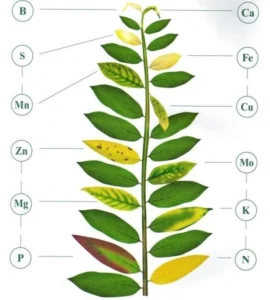
Nitrogen deficiency is expressed by certain symptoms. The most common is yellowing of the lower leaves with pale green leaves in the upper part of the plant. You may notice weak branches or shoots. However, in some kinds of plants, you can see purple stripes on the stem. If you do not pay attention to these symptoms, the yield can be significantly reduced due to poor plant development.
Why does it happen? Nitrogen is a key component of plant proteins that promotes healthy growth. Deficiency of this element leads to yellowing and stunted growth. Nitrogen also plays an important role in the formation of chlorophyll, which is necessary for photosynthesis. This element is also involved in enzymatic reactions and plant metabolism.
To prevent and eliminate nitrogen deficiency, you need to use Wonder Leaf Violet.
It is also important to pay attention to phosphorus deficiency. Leaves that suffer from phosphorus deficiency can turn dark green color, which can have a purple, bronze or red tint. At the same time, plant growth will also be slowed down. If the symptoms of this element deficiency are not eliminated, brown spots and necrosis may appear on the leaves.
Why does it happen? Phosphorus plays an important role in plant functions. This element is not only a key component of plant DNA and RNA. It also plays an important role in such essential functions as cell division, photosynthesis, plant development and protein synthesis. Phosphorus contributes to the overall hardiness of plants, helping them to resist diseases and other health problems.
To prevent and put away phosphorus deficiency, we recommend using foliar fertilizers for fertilization and fertigation – Wonder Leaf Blue, Wonder Leaf Mono P30.
How can you see potassium deficiency? The most common symptoms of potassium deficiency are brown or “burnt” leaf edges and tips, combined with chlorosis between leaf veins. You can also notice purple spots on the underside of the leaves. Potassium deficiency can cause leaf necrosis, slow growth, and make your plants more susceptible to disease.
Why does it happen? Potassium plays an important role in plant health and development. This nutrient helps to control water absorption, promotes photosynthesis and fruiting, flowering and disease resistance. Potassium also regulates plant stomata, which control water loss and gas exchange.
To prevent and eliminate potassium deficiency, we recommend using Wonder Leaf Red for foliar application and fertigation.
How does calcium deficiency appear and what are its effects? It affects the new leaves and growth points of the plant, resulting in new leaves that look dried up, stunted or curled. A tip burn is also common. In tomatoes and peppers, calcium deficiency can lead to flower apical rot.
Why does it happen? Calcium plays an important role in the healthy development of plants. It is important for cell formation and helps to hold cell walls and membranes together, as well as promotes the creation of new cells. That’s why calcium deficiency affects the growth points of plants.
To prevent calcium deficiency, we recommend using Wonder Leaf Mono Ca 14 foliar fertilizer for fertilization and fertigation.
How does magnesium deficiency appear? If you don’t pay attention to magnesium deficiency in time, its growth can be stunted. At the same time, plant parts may suffer from necrosis. In case of deficiency, interveinal chlorosis spreads from the edges to the middle of the leaf blade. Small veins also become chlorotic, however, the main veins initially remain dark green and the leaf becomes pale. Tomatoes, apples, potatoes, raspberries, and rhododendrons mainly suffered from magnesium deficiency.
Why does it happen? Magnesium is a key component of chlorophyll, which makes plants green, and also plays a crucial role in photosynthesis. This means that magnesium is essential for optimal plant health as well as for continuous growth.
How does sulfur deficiency appear and what does it affect? Symptoms of deficiency of this element appear on the upper part of the plant, namely on new leaves. New leaves acquire a chlorotic appearance, turn pale green and later turn dark yellow. You may also see stunted growth of these new leaves, and in some plant species, the stem and leaves may turn purple. It is important to note that the signs of sulfur deficiency are similar to nitrogen deficiency signs. The difference is that nitrogen deficiency causes the leaves of the lower tier to turn yellow and die. With a lack of sulfur, growth points are damaged, young upper leaves turn pale green, and the color of the leaf veins also becomes light.
Why does it happen? Sulfur has many functions. This nutrient is a component of chlorophyll and contributes to protein synthesis. In addition, the optimal amount of sulfur will ensure that your plants use nitrogen properly.
One of the signs of iron deficiency is interstitial chlorosis. The emerging young leaves turn pale or yellow, while the leaf veins remain darker. At the same time, new shoots die off, starting from the top.
Why does it happen? Iron plays a key role in the formation of chlorophyll. Chlorophyll not only gives plants their green color, but is also important for photosynthesis. To prevent and eliminate iron deficiency, we recommend using Wonder Leaf Mono Fe 10 foliar fertilizer for fertilization and fertigation.
Zinc deficiency mainly affects the new leaves of your plant. In addition, these leaves may show spots of necrosis. The leaves may look smaller than expected, with spots or bronze.Thanks to the shorter internodes, the new leaves can also grow in rosette-shaped groupings.
Why does it happen? Zinc plays an important role in maintaining plants’ health. It helps plants produce chlorophyll, enzymes, sugars and proteins.
For the prevention and elimination of zinc deficiency, we recommend using Wonder Leaf Mono Zn 8 foliar fertilizer for fertilization and fertigation.
Stunted and deformed plant growth is one of the most common signs of boron deficiency. It affects the roots and shoots of plants, the roots become thick and short with swollen root tips. Sometimes a large number of small secondary roots can grow, leading to a phenomenon known as the “witch’s broom”.
With boron deficiency, old leaves will look dark green and glossy. New leaves will be fragile, and necrotic spots appear on the edges and throughout the leaf plate. The resulting shortening of the stem internodes leads to a depressed appearance. New leaves may also have a “rusty” appearance.
Why does it happen? Boron is important for the vegetative and plant reproductive organs. It plays a role in cell expansion and carbohydrate transport.
To prevent and eliminate boron deficiency, it is necessary to use fertilizers for foliar feeding and fertigation – Wonder Leaf Pink, Wonder Leaf Mono B 11, Wonder Leaf Mono B 120.
Copper deficiency usually appears on new leaves in the upper part of the plants, as well as on growth points. New leaves become stunted or wilted with necrosis spots. Depending on the type of plant, the leaves may turn bluish-green and have interveinal chlorosis. In this case, the leaves turn yellow and the veins remain green. Mature leaves may begin to fall off, and flower development will be impaired.
Why does it happen? Copper plays an important role in the formation of chlorophyll, playing an important function in photosynthesis. This trace element is also essential for respiration, enzyme activation, and cell membrane metabolism.
To prevent and eliminate copper deficiency, we recommend using Wonder Leaf Mono Cu 6 foliar fertilizer for fertilization and fertigation.
The most common symptom of manganese deficiency is interveinal chlorosis of young leaves. The leaf becomes pale or yellow, and the veins remain green. If there is a lack of manganese, leaves edges may also remain green. Dark or necrotic spots appear on the leaves.
Manganese deficiency affects growth, roots, shoots and leaves, and leads to decreasing plant size. Why does it happen? Manganese performs a number of different functions for plant health and development, including chlorophyll formation, photosynthesis, and cell division.
For the prevention and elimination of manganese deficiency, we at Wonder suggest using Wonder Leaf Mono Mn 11 foliar fertilizer for fertilization and fertigation.
Molybdenum deficiency usually appears on the lower plants leaves, which begin to turn spotted yellow at the edges. The rest of the leaves may turn light green.
As this deficiency progresses, leaf margin necrosis may be observed and leaves may become narrow or deformed.
Why does it happen? Molybdenum is essential for a variety of plant growth processes, but is required only in small amounts. This trace element is essential for the conversion of nitrogen into ammonia and optimal plant health.
To prevent and eliminate molybdenum deficiency, we recommend using Wonder Leaf Mono Mo 3 foliar fertilizer for fertilization and fertigation.
It should be noted that recommendations for correcting mistakes in cultivation are made on the basis of data obtained through agroscouting. For example, if a certain element deficiency is shown in the field, certain actions are taken to eliminate this problem. But, these actions can cause a decrease in yield. During the growing season, usage of plant foliar nutrition comes to overcome the deficiency of nutrients. Mineral nutrients, which are usually absorbed by the roots, can also be absorbed by the leaves if applied in the form of solutions. Fertilizers dissolved in water penetrate the leaves through the stomata and cuticle. Firstly, the nutrients cross the epidermal barrier, and only then they come to leaves cells and plant organs.
When treating crops with fertilizers, it is necessary to take into account the factors that affect the application:
- Water parameters (pH and hardness). This information will help to eliminate the negative effects of calcium and magnesium and improve the properties of the tank mixture of components.
- Environmental factors (wind speed no more than 5-7 m/s, recommended temperature from 15 to 25 °C (air humidity should be at least 60%).
- Characterization of plant vegetation (plant structure, plant height, leaf density).
- Physicochemical properties of the product (surface tension, viscosity, edge angle, moisturizing qualities, wear-reducing additives).
- Technical conditions (speed, distance between the equipment and the crop, water quantity, pressure, nozzle type, sectional or nozzle shutdown, nozzle clogging).
Therefore, in order to get a good harvest, it is necessary to take care of providing plants with all the necessary nutrients before sowing, having previously conducted an agrochemical analysis of soil.