The countries’ natural resource base and the intelligent approach of farmers guarantee rich harvests. But some factors cannot be graded and conquered even by knowledge and innovation. Climate and environmental conditions change the physical and chemical properties of soils, affecting the productivity of terrestrial ecosystems and the ability to generate a certain amount of biomass.
Temperature changes during the growing season even by 1 °C can significantly impact the process of plant development. For example, wheat ripening will accelerate by a week, and corn even by 2.
Similar temperature shifts change the rainfall regime, increasing the risk of soil erosion.
In the article, we will consider the expressions of global climate changes and all the ways of reducing the negative impact on the harvest due to the timely usage of necessary fertilizers.
How to reduce the results of negative effects on the plant by correctly and timely usage of fertilizers
There are primary (direct) and secondary (indirect) factors of climatic conditions that can affect plants development and the efficiency of fertilizer use. Evolutionarily, plants maybe can adapt to the existence conditions (this is evidenced by heat, drought and winter resistance of varieties and hybrids), but frequent and significant influence of negative climate-forming factors can deplete the crops and even cause their death. Let’s consider separate factors and their impact on plants and fertilizer digestibility.
| Type of factor | Impact factor | Impact factor |
Primary (direct)
|
High temperatures | At the cellular level, they provoke the destruction of chlorophyll, proteins and nucleic acids. As a result, indicators of the photochemical activity of chloroplasts, carbohydrate, nitrogen and lipid metabolism of plants decrease. |
| Freezes | Lead to complete or partial loss of turgor, destruction of chlorophyll and color change. The rate of metabolism, growth processes decreases. After the loss of physiological functions due to the disruption of nucleic acid metabolism, the plant dies. | |
| Atmospheric and soil droughts | The most significant damage is caused during periods of active growth and formation of generative organs, damaging the root system and reducing the intensity of photosynthesis processes. At the cellular level, polymeric compounds, polysaccharides, and proteins are broken down, which is the cause of the accumulation of harmful concentrations of ammonia, disruption of cytoplasmic structures.
Lead to plants death with co-occur intense insolation. |
|
| Thermal shocks — short-term effects of temperatures above 45 °C | Minimize protective reactions against viral and fungal infections. At the cytoplasmic level, there is inhibition of movement, an increase in the density and coagulation of the cytoplasm and membrane semi-permeability. Pathological respiration occurs in plants, toxic substances are formed and accumulated. | |
| Excessive cloudiness, poor lighting | Process of tillering stops, the development of the root system, tuber and root crops deteriorates, the total mass of above-ground plant organs decreases due to a slowdown in the assimilation of nutrients. At the cellular level, the content of chlorophyll, nitrogenous compounds, sugars and other elements decreases. | |
| Floods | Floodwaters can move harmful and toxic substances into plant-growing areas. Long stagnation causes the crops’ death: rye dies in 8–10 days, wheat in 7–8, barley in 5–6, oat germs in 10 days. | |
| High solar radiation | Infrared radiation suppresses metabolic processes capable of changing the content of water, salt, phytohormones and proteins in the cell.
The anatomical shape of the leaf is lost with prolonged action of the factor. Buds and fruits that have just formed may fall. |
|
Secondary (indirect)
|
Shifts of cultivation area of certain plants | Species and types that have already “accustomed” to certain temperature conditions will not adapt to new ones. The efficiency of fertigation measures decreases to 60 %. |
| Appearance of pests and diseases | Many bacterial diseases spread due to damage by agricultural tools and fallouts in the form of hail, heavy rain, wind gusts that injure plants. Pests appear in fruits, stems and leaves that can infect organs with viral and bacterial diseases:
|
|
| Formations of soil erosion | Erosion appears as a result of the movement of the upper layer of the earth, improper use of herbicides. It leads to a range of plants diseases:
|
The environmental impact and the lack of nutrients in the early stages of development are the first things of plant growth delay, which can cause yield decrease.
Determining the lack of necessary micro-, meso-, or macroelements is accompanied by a visual inspection and culture diagnostics. The earlier effective fertilizers are chosen, resuscitation actions are planned and implemented, the lower the risk of crop loss.
Fertilizers by WONDER production are true helpers for supporting plant development in critical periods under the influence of negative environmental and climatic factors. The products consist of exclusively high-quality raw materials, which are the basis of unique effective formulas.
Certified fertilizers for foliar feeding in liquid and crystalline water-soluble forms provide complex and balanced plants nutrition. Let’s overview products that will help to minimize the impact of adverse environmental conditions.
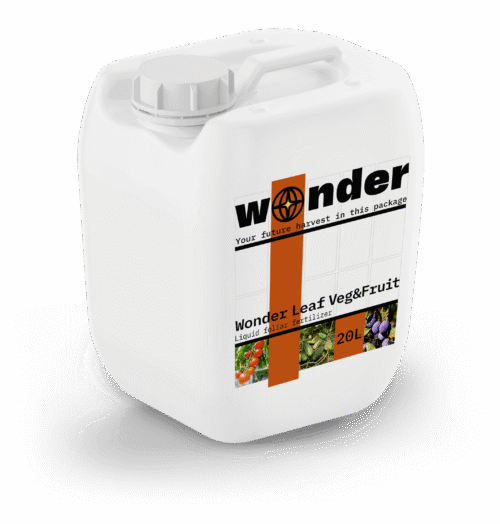
The best foliar fertilizer that prevents the deficiency of micronutrients in critical periods, stimulates strong stems and leaves development, improves the development of the root system even under the influence of negative climatic factors.
The recommended proportion for use in a tank mixture is 1–2 l/ha.
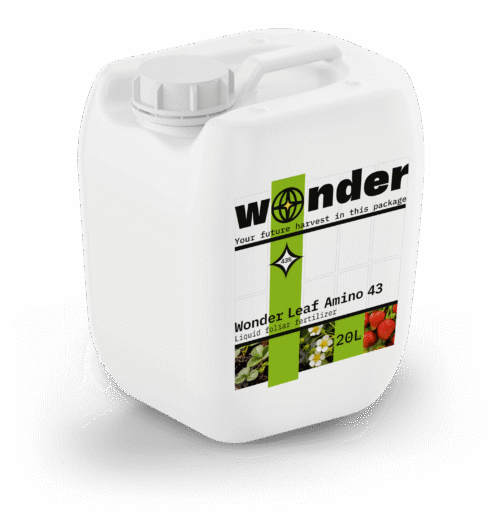
It contains 43 % amino acids of vegetable origin and 8.5 % organic nitrogen, stimulates the absorption function of crops, which helps plants to recover from stress. The fertility of pollen grains increases (zygotic potential rises), which improves pollination and increases the foliar feeding and yield level of fruit and vegetable plants.
We recommend application to the tank mixture in the proportion of 0.5–1 l/ha.
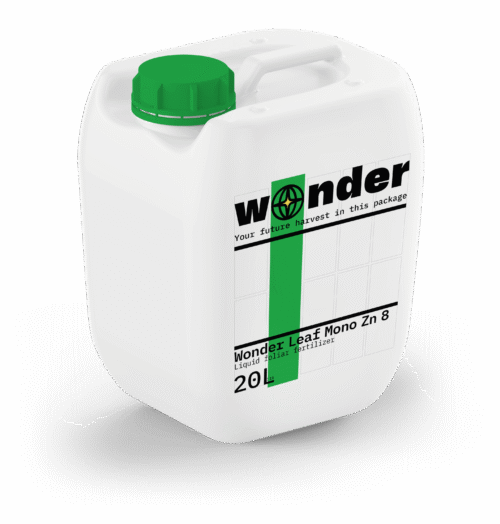
Liquid mineral foliar fertilizer has a formula rich in zinc, a trace element that is responsible for frost and drought resistance, enhances the synthesis of protein, carbohydrates and starch.
We recommend using it in a tank mixture at a volume of 1 l/ha.
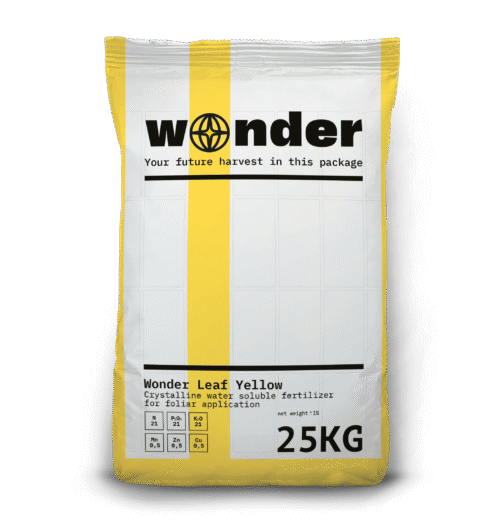
Balanced, universal, crystalline, fast-dissolving foliage fertilizer with a high content of available forms of macro- and microelements in chelated form.
We recommend applying foliar fertilizer by 2–4 kg/ha to the tank mixture.
View all the available WONDER fertilizers for foliar feeding by following the link.
Consequences of over- and underuse of fertilizers
For the full assimilation of fertilizers, the absence of weeds, sufficiently moistened soil, compliance with the regime, and most importantly, the use of the recommended proportions are required. The norms specified by the manufacturers must be taken into account since insufficient amounts of fertilizers lead to loss of funds, overuse — damage to plants, and even harm to the soil as a result.
If everything is clear with underuse — the effect of use will be completely or partially absent, then what will happen to the soil and crops if too much fertilizer is applied? We often face such cases in the network. The opinion is especially widespread that during fertigation, namely surface irrigation, some forms of fertilizers don’t migrate well deep into the soil, so you need to buy “with a margin” and increase the dosage rate of the manufacturer. Such irrational use and neglect to observe the measure negatively affect the development of plants. Among the consequences of the overuse of fertilizers:
❌ salinization, dehumidification, decalcification of the soil;
❌ deterioration of the absorption complex of soil cations, change in alkalinity indicators;
❌ formation of solon soils;
❌ violation of the vegetation process, delayed flowering and ripening of crops;
❌ tendency of plants to lie down.
The consequences of using fertilizers will live up to expectations if you follow the recommendations of expert agronomists. Have any questions regarding ordering or pricing for fertilizers?
We will answer all questions, advise how to apply mineral fertilizers for their effectiveness. Personal
consultation is free.
Call us: +38 067 0000 304.